What an awesome disaster of a movie. Panned at Cannes, left for dead by Sony, eventually raking in $300K on an $18 million budget and forcing a promise from Richard Kelly that he will be more commercial in the future, I now say that it’s the major American movie of 2007 that I enjoyed the most, far more than limp critic-fodder There Will Be Blood and No Country for Old Men. It certainly isn’t a good movie, though there are plenty of good bits in it, but the movie, at least partly unintentionally, has been constructed in such a way as to make such evaluations meaningless. Southland Tales will never be ridiculed and celebrated the way Showgirls or Valley of the Dolls or Manos: The Hands of Fate or Battlefield: Earth are. It doesn’t provide enough reference points. James Wood, in one of his bon mots, said of Kazuo Ishiguro’s The Unconsoled, “It invents its own category of badness.” Wood was wrong, for The Unconsoled is just a mediocre symbolist text (see Alasdair Gray’s Lanark for a far more brilliant effort in the same vein). But Southland Tales comes as close to that description as any film in recent memory, and where it is in its own category, there is no comparable “good” to be had next to the bad. Its idiosyncratic overambition lies alongside O Lucky Man! and its acknowledged antecedent, Kiss Me Deadly. I don’t know that it is as seminal as the latter film, which for me is one of the greatest American films of its era, but as with Kiss Me Deadly, it won’t be possible to tell until we are further from the present. It’s that sort of a zeitgeist movie; maybe it’ll look as awful as Dennis Hopper’s The Last Movie or Jodorowski’s films, but I hope not. I got a real kick out of it.
Let’s start with the logo.

Does the oddly-colored shape under the title look familiar? I was pleased with myself for recognizing it. It’s a US electoral map from 2004, skewed by congressional district so that each district’s size is proportional to its population, and color coded red-to-blue to represent Republican-to-Democratic dominance. It’s ugly, oversaturated, politically allusive, and obscure all at the same time, and it’s a good synecdoche for the film.
The film fails in making any coherent political statement, because you can’t make any sort of political statement in the midst of such chaos. The plot, such as it is, has to do with The Rock playing an amnesiac actor married to the daughter of the Bush-a-like Republican presidential candidate (this film takes place in 2008; the Democratic ticket is Clinton-Lieberman). His name is Boxer Santaros, but he’ll come to be known as Jericho Cane, the lead character in a screenplay he has written (or has he???) about the apocalypse. Also collaborating on the screenplay is Sarah Michelle Gellar’s Krysta Now, a porn star/talk show host who may or may not have Marxist revolutionary tendencies. (It may be possible to figure out the actual affiliations of many of the characters, but, like most of the plot elements, it is largely irrelevant.) What glimpses we have of this screenplay reveals that it is pretty much the sort of screenplay The Rock would have written: a macho action hero killing people, spouting banal dialogue, and chugging Bud Light. Here’s page 1:
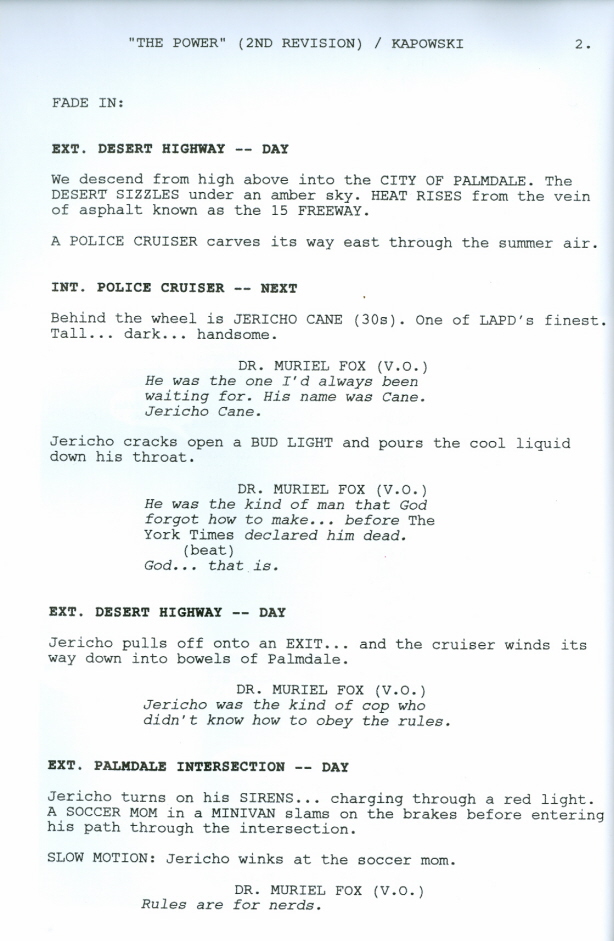
(If you don’t find that funny, this movie might be extremely painful for you.) Anyway, through a combination of subversive revolutionary action, plain accident, and assorted other Philip K. Dick-ian causes, the screenplay is being acted out in reality by people who don’t even know of it, as well as observed by all the other characters and by the actors themselves. Since the script is about the apocalypse, things get very strange in a hurry. Some neo-Marxists attempt to fake a shooting to turn the population of California against the government’s draconian anti-terror laws, instituted after two nuclear bombs exploded in Texas. Justin Timberlake plays a mutilated Iraq veteran who spends his days spying on (and occasionally killing) people from offshore through a giant rifle sight. He and several other characters have had megadoses of the mysterious Fluid Karma, a substance that causes telepathy, shared dreams, the mixture of fantasy and reality, and so on and so forth, like Chew-Z in Dick’s Three Stigmata of Palmer Eldritch. It’s also a clean fuel that will save the world, according to a bunch of German scientists led by Wallace Shawn. And at ground zero of this mess are a bunch of morons getting sucked into their own screenplay in the middle of Los Angeles, already shot, with the exception of one critical scene, to be apocalyptically unreal. I could go on and on, but you get the idea.
As these stars act out their wretched screenplay, it’s obvious that at least some of the badness of the acting, dialogue, and plot is intentional. But Kelly makes it impossible to separate the intentional from the unintentional, because the crap script mixes with “reality” to the point that they are inseparable, and none of the “real” characters are any smarter than their in-script standins. This is obvious early on, from the moment Krysta Now says “Apparently, the future is much more futuristic then scientists thought,” but also evident from the sheer lack of any empathetic characters. And I haven’t even mentioned the Justin Timberlake video embedded in the movie, done up as a tribute to The Big Lebowski. The movie is impressive in its self-referential textuality, as bad actors play bad actors writing bad screenplays with bad characters that they then become the bad stars of. (The Rock does a magnificent job of acting like he has no idea what’s going on.) Most of the cast are famous for anything but dramatic acting and can only be recognized as themselves, not as characters within a movie. This movie oozes Verfremdungseffekt.
If nothing else, these factors ensure Southland Tales a place in post-structuralist theory for years to come, a bitterly appropriate result. Still, that’s not to deny the disorienting effect the movie has in providing no reference point whatsoever to what would be called “real life.” It’s spectacle all the way down. But what spectacle! Kelly has given himself over to the pop culture overload and distilled it more densely, and authentically, than anyone since John Oswald. (The opening pastiche of news channel graphics, logos, and crawls is dead-on, the best anyone has done since Chris Morris’s Brass Eye.) And to Kelly’s credit, he never loses his grip, never sacrifices the miasma to anything that could dare be called “art,” which is why Cannes hated him and loved Tarantino. Even if Kelly was trying to elevate (quite literally, at points) his material, he never does.
So let’s go back to Kiss Me Deadly, which appears twice in the film and is clearly a major influence on Kelly. Aldrich’s film is a joke at everyone’s expense, a contemptuous reading of a Mike Hammer novel portraying Hammer as a dull-witted thug incapable of understanding the true stakes of what’s around him. Even the entire genre of detective novels is held up for ridicule when the McGuffin at the center of the story turns out to be anything but irrelevant. The acting ranges from lumpen to histrionic and never matches the unstable material. But unlike Southland Tales, it comes together to damn every bit of its source material and America with it. In Southland Tales, things are inverted: the fools understand and we do not, because the fools are generating their own story, and we–and I include director Kelly in that–are getting caught in it.

19 March 2008 at 09:56
This is a useful take on this – I saw this when it came out with an audience of maybe 12 in New York. I wonder if seeing an unedited version would change things. The movie I saw had obviously been quickly chopped up and seemed to have lost a lot of sense that way, but I’m not sure if that’s a good thing or not, as you get to. I also remember liking Donnie Darko in its original run & then seeing it on DVD with director’s commentary which utterly ruined the movie – Richard Kelly takes himself too seriously, and the ambiguity that I liked in the movie didn’t seem to be intentional on his part.
19 March 2008 at 18:51
Hey, check out the “(Alternate) Knight Rider” video below: it embodies all the promise Southland Tales (highly allusive, pop culture references; voiceover; protagonist who is a cipher; postmodern aspirations; evocative and retro music; special effects incl. rocket launcher) without many of the weaknesses (apocalypse plot, annoying dialogue, length)… :)
– Mrs Waggish
20 March 2008 at 09:45
I gave this movie two chances. One in the theatre, and one at home, where I watched it again last night. The first time I didn’t like it and the second time I hated it. Why can’t everyone just admit that this is a bad movie? Kelly has no idea what he is doing, and I guess it’s his luck that that kind of aesthetic choice is in vogue right now considering the supposed vagaries of life in the 21rst century. But what tips me off that Kelly is out of control is that he has no sense of humor. That’s the difference between someone like him and Tarantino, although the two of them should never be mentioned in the same sentence. Southland Tales comes off like it was made by someone who just smoked pot for the first time, and cheap pot at that. It is Kelly’s misfortune that people must have told him he was a genius at an early age, because he seems trapped in amber, the world’s smartest 11 year old boy. And if we’re talking Zeitgeist here (and the idea of capturing the zeitgeist is to me the most overrated attribute one can place on a work of, um, “art,”)I would nominate Zodiac as capturing our current situation better than any Hollywood movie of the last year or so, through sheer absence of the present tense, if that makes any sense. I think everyone wants to find something great in ST, maybe it has to do with nostalgia for Donnie Darko and what life was like back before 9/11, I don’t know, but I’m getting a feeling that Kelly is the emperor’s new clothes. Kiss Me Deadly? Holy Mountain? I don’t think ST will be spoken of in terms of those movies. ST reminded me of Megaforce, if anything, a tacky quasi-sci-fi schlockfest.
20 March 2008 at 22:49
the more i hear about this movie, the more i think i’m going to like it. i’m wondering how it might compare to two of my other contrarian faves: a.i. and rafelson’s head?
14 April 2008 at 00:58
So.. the reason everyone hates this movie.. is because they don’t understand it.. haha.. pretty funny
20 April 2008 at 14:53
I’m glad to see that you’re exposing the public to this film, but I’m left wondering: has America completely lost its sense of humor or the satirical? Are we buying the very things that this movie lampoons to the extent that we are the characters in it? There are two films that came to mind when I saw this, and I wonder how either one would be received if they had premiered now in today’s political climate: Network and Dr. Strangelove, filtered through David Lynch. Now I’ve only seen the recut on DVD, did not see the Cannes premiere. Maybe it needed help at that point. But the DVD version that now exists is one of the most brilliant pieces of satire I’ve seen recently. Only thing that comes close in an admittedly much more comedic form is Idiocracy. Another film forced to fly under the radar while Hollywood remakes stinking horror movies that sucked the first time, not to mention what they’ll stink like now. But that’s OK, I guess, since they seem to be doing well at the box office. So I don’t get it. Guess maybe the american public should soak itself in electrolytes. Because, after all, that’s what vegetables crave.
20 April 2008 at 23:46
Thanks for the thoughtful and honest review. Many critics would rather turn away and call it crap than use their brains and see what that crap is all about.
While watching the film, I gave up trying to figure out what was happening about half an hour in. But for the rest of the time, I was lost and delighted. And, for the first time in quite a while, I became immersed in a film. Is it better to understand a straightforward regular plot that bores you or be stimulated by one that you cannot understand and makes little sense anyway? Have we grown so stubborn as viewers that plot lines cannot be organically grown as artistic forms themselves?
I may be mistaken, but the film is a graphic novel adaptation. A reader of comics or graphic novels would have no trouble digesting the contents of the film. Adapting a comic of book to a digestible film has always been a challenge for film-makers. The sense that Kelly did not attemt to adapt the graphic novel to film, but tweaked the film towards the graphic novel is what meade it interesting for me.
Yes, it has flaws, can be hard to watch and can even be called bad. But I think it’s boldness will, in time, ensure it’s status as a cult classic . And good or bad that will give it longevity that many Cannes Film Festival picks simply wont have.
5 May 2008 at 21:24
The movie is only the last 3 chapters of the story. The first 3 chapters are done in graphic novel form. Reading the graphic novels makes a world of difference as I feel this movie is incomprehensible without them.
10 May 2008 at 05:24
i actually looked forward to seeing this movie simply because it got such a bad reception at Cannes…and i loved it. i won’t lie. yes, the whole orwellian-big brother/story-within-a-story style did take a bit getting used to, but once i got over all the preconceived ideas i had about what i should be seeing, i just let the movie flow and enjoyed what i was seeing.
i’ve seen the movie three times now, and i plan on seeing it again. there’s just so much going on and so many references that i find myself discovering them during repeat viewing. and i agree with a previous poster. a good movie should be challenging. it should have you question and debate and complain long after the credits roll. yeah, yeah. roll your eyes if you want to, but c’mon…a movie like this is very rare these days. at the least, you could say you remember this movie ten years from now.
just a little sidenote, too. i like how Three Stigmata of Palmer Eldritch was mentioned earlier because in one of the earliest scenes in Southland Tales, where Sarah Michelle Gellar’s Krysta Now is in bed with The Rock’s Boxer Santaros, Gellar’s character says “Stigmata.” that’s just something i find very interesting.
18 May 2008 at 18:08
Wow. I’ve just discovered this site and just seeing the word ‘Zeitgeist’ so many time is a guilty pleasure. I can barely understand what you guys are talking about, but I love it when someone exclaims about some incomprehensible piece of shit: “It’s actually brilliant satire!”
4 June 2008 at 09:05
After watching the film twice (I fell asleep the second time, but I did wake up for the …climax?…) and an hour of reading critiques and synopses, I still don’t get what the movie was about.
Was Kelly suggesting that God is directly influencing U.S. politics and homeland security.
I feel much dumber than usual and that I’ve been left out of an inside joke, …again.
8 June 2008 at 16:54
I really wanted to like this movie. It has a very cool premise and is very stylish—in places. In the end it just felt watered down and unsatisfying. I think the movie could have been better if the Boxer Santeros character was a sidenote and the plot focused more from the perspective of Roland/Ronald Taverner.
17 July 2008 at 07:05
I personally fell across the movie by accident. I went to visit a friend of mine, and his son was about 20 minutes into it. I came into the movie about when they pull up to the domestic couples house and all hell breaks loose. I watched it then, then borrowed from my friends son and watched it again at home. Still didn’t get it. Then It accured to me. I should seriously have my grandmother watch this. Perhaps she’ll catch something I don’t. Here’s my small theory.
My grandmother being very religious SWEARS up and down that the end times are coming. The movie mentions it. Briefly. Vaguely. Almost not at all. Yet God is mentioned. Barely. And scripture is read in same context. I question if a majority of this movie is almost subliminal.
The use of REAL LIFE situations, things about bush, the weather troubles, the wars across seas. According to my grandmother all these things are really happening, BUT they are mentioned in Revelation that they were going to happen. So, if its an all star cast. Why would they have made it if the script was so bad? Whats the reason behind it? What do they see. Is there an ACTUAL message that this movie is sending that we aren’t getting? I’m just throwing out my thoughts for someone to comment on. Perhaps Im in the wrong direction? Perhaps we are getting told something?
23 September 2008 at 14:41
I bought this dvd about a week ago and i have already watched it 6 times at least. for some reason i cannot help but to go back and look for things ive missed. i find more and more things everytime. this movie has a real ‘fear and loathing’ vibe to me crossed with a few other mind screwing movies. maybe its just me but i like movies that make my mind work for what the message is.
Not only that but some of the best movie quotes i have ever heard are in this movie. I even liked the musical. I think everyone is missing the point on this. Boxer was supposed the main character but its really roland tavener or even pilot abeline that people should study.
With all the referals to the bible and robert frost, it really makes the end of the world seem very possible in a cerain sense.
Of course then again maybe im just happy to finally find a movie that shows the patriot act’s true intentions.
Anyhow that was my 2 cents
5 May 2009 at 22:09
Here is my interpretation of Southland Tales, for those who don’t get it.
I sent my theory to Richard Kelly and he approved.
I’ll begin with the basis. The film is about two main ideas, and the ultimate one. God vs. the devil, and Capitalism vs. communism. The Baron represents both the devil and communism. Ultimately, however, at the very bottom the film is about the battle for the soul of Boxer Santaros.
Notes on characters:
Boxer Santaros – Movie star who the devil wishes to make a god to fulfill a prophecy, and fails.
Krysta Now – Celebrity who has made a deal with devil to further contribute to the perversion of man.
Ronald/Roland Taverner – The true messiah, the second coming of Christ who comes back on a white horse (the ice-cream truck)
Pilot Abilene – He is a prophet. He knows the true messiah and speaks his word. He is a Watcher. When he took fluid karma he could enter Heaven, where Marilyn Monroe is. “I’ve got soul but I’m not a soldier,” means that no matter what I will be a soldier of God first and a soldier of your phony war second. The scene in the Fire arcade is pretty powerful stuff, imho.
Baron von Westphalen – He represents the devil, and does his work on Earth. He silently controls the whims and covertly controls the masses through his manipulation of ocean waves through the fluid karma tidal generators. He makes deals across the board for the souls of those around him, and for the souls of the masses. I believe that selling the baron your finger means selling him your soul. The exchange of thumbs are the exchange of souls, the marxists foolishly supporting the true agenda of the devil.
Inga von Westphalen – Marx’s granddaughter? Baron’s mother. Represents the coexistance of the devil and marxist theory.
Bobby Frost – The puppet at the hands of the baron.
Nana Mae Frost – She represents authoritarianism, and is ultimately defeated (shot to death) by anarchism.
Madeline Frost Santaros – She is a slave who cannot free herself from the agenda of the baron. Her job was to marry Boxer, and she really does love him (probably under some demonic love spell). She is not an evil character, as she tries to expose the baron in one scene. The baron comes out with evidence against her to slander and discredit her, further representing her slavery. She cannot help but to be led into the destruction of the Treer Megazeppelin. Boxer tries to warn her but she cannot hear it.
Cyndi Pinziki – Head of the neo-marxists. The blackmail of Bobby Frost further represents the fight between capitalism and marxism, as it is natural for a marxist to try to get at some of the capitalist’s money. Her scenes with Vaughn Smallhouse are about capitalism vs marxism even though at the end of the day, they come together and kiss (in the Cannes cut). Ultimately, marxism and capitalism are both the same thing in the end, because they are both covertly controlled by agents of the baron.
The baron even says that the marxists don’t know anything about Karl Marx. Indeed sir, they do not.
Dion and Dream – Neo-marxist revolutionaries. The celebrities and activists who are also are sacrificed. They do not understand marxism at all, like most celebrities, and ultimately are led to the slaughter.
Zora – Represents betrayal and is an unwitting agent of the of baron’s agenda. Krysta is her handler and she is in love with her (Later killed in a shootout with a “fascist pig,” how ironic).
Bart Bookman – He is simply a man who does not care about life. He foolhardily throws himself into eternal darkness.
Martin Kefauver – The angel of death. Destroyer of Babylon, the Treer Megazeppelin (named after Jenny Von Westphalen, interesting stuff)
Serpentine – She works for the baron, but she knows the true prophecy. She represents the innate division in the house of evil.
Dr. Katrina Kunzler – Also knows the true prophecy. She is a seer.
Simon Theory – Represents science, and is aligned with the baron. Represents atheism and rational thought, as it is completely rational that Boxer would commit suicide, but to subscribe to that theory would be to ignore the obvious truth. That he is a pimp, and pimps don’t commit suicide.
Dr. Soberin Exx – A mad scientist exceeding far beyond the moral boundaries of science. Dangerous science. Dangerous for all of us really.
Fortunio Balducci – Works for the baron, but covertly works for the anarchists. His quote in the beginning about social upheaval in the beginning was him just phoning in the performance of neo-marxism. He is a secret capitalist.
Krysta’s porn star friends – The porn stars surrounded by Krysta are obviously dimwitted, and represent a certain portion of those in our culture who are also godless and being led astray. This is evidenced by their views on abortion and promiscuous sex.
Walter Mung – He works with the anarchists. He kidnaps Ronald and keeps him secure in order to fulfill the true prophecy, and also gives Martin the missile launcher. The anarchists in the film work covertly, so covertly that their agenda is fulfilled through whispers under the surface. The anarchists represent the true political and spiritual underground of the film.
“This is the way the world ends, not with a whimper [apocalyptic baby fart] but with a bang [destruction of Megazeppelin.]
The end of the world might not be the literal apocalypse that the baron wishes for, but with instead the creation of a new world.
I dig this film, even though a lot of it looks cheap. And I find Kelly’s sense of humor well tuned too. One of my top 20 I would say