No-one here to hear. Tonight deftly amid wild drink and talk, to pierce the polished mail of his mind. What then? A jester at the court of his master, indulged and disesteemed, winning a clement master’s praise. Why had they chosen all that part? Not wholly for the smooth caress. For them too history was a tale like any other too often heard, their land a pawnshop.
Had Pyrrhus not fallen by a beldam’s hand in Argos or Julius Caesar not been knifed to death? They are not to be thought away. Time has branded them and fettered they are lodged in the room of the infinite possibilities they have ousted. But can those have been possible seeing that they never were? Or was that only possible which came to pass? Weave, weaver of the wind.
Ulysses I.2
This passage (ominously quoted by the Times sportswriter before he said “It is clear that the International Cricket Council (ICC) has been pondering long and fruitfully on this text from the great book”) is thought by Stephen early on in Ulysses, and I read it as one of the most evident unifying points between Ulysses and Finnegans Wake. Stephen and Bloom both blatantly invoke the difficulty of accepting the past, Stephen with his “History is a nightmare…” attitude and Bloom with his entire family life and family history. (And really Stephen with his family as well, for family and death are two of the great Catholic/Platonic pillars around which Joyce’s work revolves.)
Specifically, the issue is one of accepting the erasure of possibilities and the cementing of tragedy by the passage of time. The obsession with alternate possibilities and counterfactuals embodies the otherworldly gnosticism that Joyce frequently rejects and ridicules. This passage in the second chapter is mirrored quite precisely by one from the penultimate chapter, when Bloom sadly contemplates “the irreparability of the past [and] the imprevidibility of the future” in abandoning the idea of Stephen as a surrogate son. Bloom comes to some acceptance of time’s branding. With Stephen it is less clear.
But I do think Joyce not only endorsed this acceptance but urged that the tragedy be memorialized and (secularly) sanctified. In the climatic passage of III.3 in Finnegans Wake, when the Four Old Men or whatever you want to call them excavate the mound of sleeping, dead HCE and the screams of history come pouring out, a torrent of war calls, mournings, and death:
— Crum abu! Cromwell to victory! — We’ll gore them and gash them and gun them and gloat on them. — Zinzin. — O, widows and orphans, it’s the yeomen! Redshanks for ever! Up Lancs! — The cry of the roedeer it is! The white hind. Their slots, linklink, the hound hunthorning ! Send us and peace ! Title ! Title ! — Christ in our irish times! Christ on the airs independence! Christ hold the freedman’s chareman! Christ light the dully expressed! — Slog slagt and sluaghter! Rape the daughter! Choke the pope! — Aure ! Cloudy father ! Unsure ! Nongood ! — Zinzin. — Sold! I am sold! Brinabride! My ersther! My sidster! Brinabride, goodbye! Brinabride! I sold! — Pipette dear! Us! Us! Me! Me! — Fort! Fort! Bayroyt! March! — Me! I’m true. True! Isolde. Pipette. My precious! — Zinzin.
The men are senile and HCE/Shaun is sleepy or dead, so there is an elegaic quality to the chapter, but here there is no hiding the raw horror, the actual and endlessly repeated fall of man. (It’s some of the least confused verbiage in the whole book; the mysterious “Zinzin” is theorized to be the ringing of the phone that the old men are listening in on.) I read it as a codification of that which must be spoken not to be forgotten, repressed, and/or ignored, in order to speak honestly and fully of the “irreparability of the past” and not think it away.
I do not have to pay $3.50 to find out what it feels like to be a Jew.
George S. Kaufman on Gentleman’s Agreement
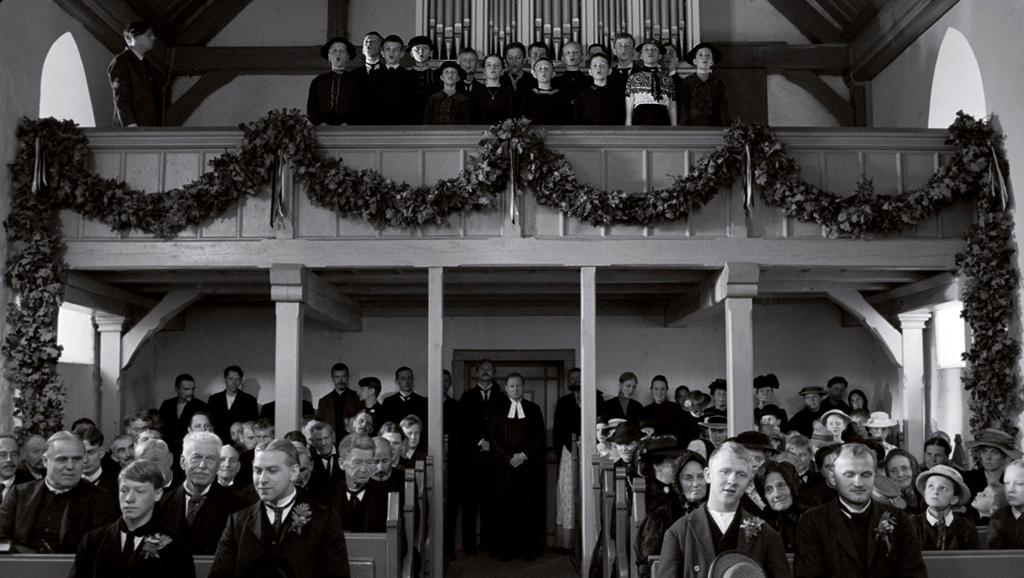
I do not like Michael Haneke. I do not like his insufferably smug brand of moral superiority. I do not like his trite attempts to indict his audiences for complicity in his violence and sadism. Worst of all, I don’t think he’s a very good filmmaker. The White Ribbon may be the most sophisticated version of Haneke’s modus operandi, as well as the least unpleasant, but the stark artiness only makes the banality of his ideas all the more obvious. (It’s harder to see banality when you’re being provoked and annoyed.) The sophistication tactic worked well enough to win him the Palme d’Or at Cannes, but if you can still respect Haneke after listening to him prate on (in the documentary 24 Realities Per Second) about forcing truth upon the audience unwillingly and how he wants to “rape the spectator into autonomy,” then you are made of more forgiving stuff than me.
Haneke’s best works, his television adaptations of Kafka’s The Castle and Ingeborg Bachmann’s Three Paths to the Lake, show a low-key filmmaker with a gift for knowing when not to press the point. That gift was evidently lost by the time Haneke foisted Benny’s Video, The Seventh Continent, and Funny Games upon the world. The message is always the same: you are guilty, everyone is guilty. And he makes sure you hear it, loud and often.
There’s not much to The White Ribbon. Set in a small German village shortly before World War I, the movie chronicles a few years of assorted bad things that happen to the landowner baron, the farmers, and the other village officials. One child is kidnapped and tortured. A doctor’s horse trips over a thin strung wire, nearly killing him. And so on. The mystery is who is doing them.
All the adults in the village are uniformly rotten except for the schoolteacher narrator, who is merely devoid of personality and who thus serves as the point of viewer identification. His older self narrates the movie in deadening, portentous tones, making explicit what was already too obvious. The more powerful the adult, the more rotten they are, and so the doctor, the steward, the baron, and the pastor are the loci of evil. As for the children, well, if you’ve seen Haneke’s last film, Cache, you will have no trouble figuring out what’s going on with them. Actually, you won’t have any trouble either way. They’re rotten too. PS: They grow up into Nazis.
The black and white photography is beautiful but sterile, the product of a director who has never matured past his infatuation with the V-effekt. Some of the performances are good, though Haneke wastes talented Austrian Birgit Minichmayr in a disposable role, and Josef Bierbichler only has a few seconds over the course of the movie to convey incredible physical menace, which he still manages to exploit efficiently. Both were used to far better effect in the “popular” Wolf Haas adaptation The Bone Man last year:
I wasted my time watching this movie when I should have been watching more Haneke.
Rainer Bock is nicely evil as the doctor (only the kids get names) and the children are creepy, but mostly the actors are more lifeless than Herzog’s hypnotized cast in Heart of Glass. (Trivia: Bierbichler was the only actor not hypnotized in that film.) The only actor seemingly given license to put some energy into his role is Detlev Buck, who plays the withering and sarcastic father of the girl the schoolteacher wants to marry. He’s evil too, but he’s funny. The whole movie should have been about him, but since he’s too entertaining and we are here to learn, Haneke only gives him a few minutes.
Now, I’m not opposed to didacticism. I can tolerate and even enjoy the essayistic work of Alexander Kluge because the ideas are original, but with Haneke it’s just the same old sermon. With the Dardennes, you get redemption and transcendence, but Haneke just wants to see you suffer. Haneke is the pastor who ties his son’s hands to the bed every night to prevent him from masturbating. He’s going to make sure we have no fun. He is the abusive parent punishing us the audience, who then grow up to be Nazis or write nasty reviews or something. If Haneke had a sense of irony, he would make something out of this, but I don’t think he even realizes the parallel. He’s a fundamentalist preaching the evils of fundamentalists.
Michael Haneke at a screening
I’m not surprised that the cinerati have eaten up the self-abnegating experience of watching Haneke, but I am surprised that few people seem to have remarked on how derivative it is. Apart from the obvious lifts from Bresson, The White Ribbon is stylistically and thematically a remake of Carl Dreyer’s Day of Wrath, and a vastly less gripping one. Dreyer sucks you in; Haneke just harangues. Whenever the schoolteacher’s narration kicks in with all the dynamism of the drearier chapters of Atlas Shrugged, you’re reminded once more of how little enjoyment you’re supposed to be having, and how important this film is supposed to be.
For contrast, take Haneke’s Austrian superior Ulrich Seidl, whose Import/Export should have won Cannes in 2007 but was too unpretentious and vulgar to do so. Seidl doesn’t skimp on showing rank unpleasantness, but it’s in the service of, to put it succinctly, life. (I got some funny looks in the theater when I said to my friend that Import/Export was optimistic, but Seidl himself says he’s a humanist, and he is.) The villagers of The White Ribbon are Protestant, but Haneke is the very caricature of the dreary Austrian Catholic painted by Thomas Bernhard. He makes dead movies; they are dead on the screen and the audience is dead in their chairs.
I saw Heiner Goebbel’s odd Stifters Dinge this weekend (made odder with the persistent head cold I’ve had), and though I think it’s senseless to try to give a concrete analysis of it, one part jumped out at me, an interview with Claude Levi-Strauss where he says that there is nowhere left unexplored in the world, no remaining frontiers. I don’t think he’s right, but humanity is definitely at a place where we finally think of the whole planet as our home rather than any one part of it. And so…
If we have to seek man’s origin in the category of animals that ‘flee,’ then we can comprehend that before the change of biotope [from jungle to savanna] all signals that set off flight reactions would indeed have the power of fear but would not have to reach the level of a dominating condition of anxiety, as long as mere movement was available as a means of clarifying the situation. But if one imagines that this solution was no longer, or no longer constantly, successful, then from that point onward the situations that enforced flight either had to be dealt with by standing one’s ground or had to be avoided by means of anticipation.
Hans Blumenberg, Work on Myth 1.1
So while Hegel thinks the primary will of humanity is desire, for Blumenberg the primary motive of primitive humanity is getting the hell out of Dodge. And when we settled down and no longer ran from place to place, an underlying anxiety originated of the anticipation of having to pick up sticks and run. (Blumenberg is more prosaic than Heidegger; he thinks life is tough enough on its own without the problems of Dasein.) And as long as we could imagine that flight, could imagine packing up and rebuilding elsewhere, the anxiety could be kept in check.
But I wonder: when you’ve filled up the planet and you know you’re stuck on it and you start to see assorted disaster scenarios that offer no refuge to start over (be they nuclear, environmental, or otherwise), what does that do to the anxiety? There’s no flight left (except to other planets, the fantasy of some optimists).
Butcher’s Crossing is the most flawed, the most peculiar, and the most exuberant of Williams’ three mature novels (he disowned a first novel, which I have not read). Unlike the near-perfect tenors of the academic novel Stoner and Augustus, Butcher’s Crossing sees some significant shifts in tone over the course of the book. All three novels are Bildungsromans, but here Williams also attempts to tell the story of the decline of the American West as well. That is why, unlike the other two novels, it is not titled after the main character but the frontier town which provides the settings for the bookends of the novel.
Will Andrews is a Harvard student who, inspired by Emerson, drops out to find himself in the great West. After arriving in Butcher’s Crossing, he funds a hunting expedition to a distant valley in Colorado where a great herd of buffalo still remain, most of the other herds having already been hunted down and killed for hides. He is naive and for a time it seems he could be easily scammed, but the leader of the expedition, Miller, is serious, and after Andrews has a slight dalliance with a whore-with-a-heart-of-gold, they set out with two other grizzled men.
So the ground for an archetypal post-western has been laid, and the themes follow those that would be used (and overused) by Cormac McCarthy, Once Upon a Time in the West, and, of course, Stan Ridgway and Wall of Voodoo:
harshly awakened by the sound of six rounds of light caliber rifle fire followed minutes later by the booming of nine rounds from a heavier rifle, but you can’t close off the wilderness. he heard the snick of a rifle bolt and found himself staring down the muzzle of a weapon held by a drunken liquor store owner. “there’s a conflict,” he said. “there’s a conflict between land and people…the people have to go. they’ve come all the way out here to make mining claims, to do automobile body work, to gamble, to take pictures, to not have to do laundry, to own a mini-bike, to have their own cb radios and air conditioning, good plumbing for sure, and to sell time/life books and to work in a deli, to have some chili every morning and maybe…maybe to own their own gas stations again and to take drugs and have some crazy sex, but above all, above all to have a fair shake, to get a piece of the rock and a slice of the pie and to spit out the window of your car and not have the wind blow it back in your face.”
“Call of the West”
And that does somewhat mimic the arc in the book. Things get immediately dire as they have trouble finding water, and less than a third of the way into the book, things do seem to be shaping up for a sheer hellishness. But they find the water and the valley, and soon enough they are hunting (i.e., massacring in large numbers) buffalo. There is a sustained, 40-page description of the early days of the hunt that may be the most focused setpiece Williams ever wrote, and the turning point in Andrews’ character.
It came to him that he had turned away from the buffalo not because of a womanish nausea at blood and stench and spilling gut; it came to him that he had sickened and turned away because of his shock at seeing the buffalo, a few moments before proud and noble and full of the dignity of life, now stark and helpless, a length of inert meat, divested of itself, or his notion of its self, swinging grotesquely, mockingly, before him. It was not itself; or it was not that self that he had imagined it to be. That self was murdered; and in that murder he had felt the destruction of something within him, and he had not been able to face it. So he had turned away.
Such introspection is comparatively rare in the novel. Extensive and careful description is more common, but when it comes like it does here, it is strikingly abstract and visceral simultaneously. I don’t know if the effect is quite successful (thought it beats Cormac any day), but it’s certainly unusual. Williams resists any broad judgments of character. If Andrews is losing his humanity, then “humanity” is not an absolute value. He is freed from this sort of condescension towards the whore that he felt earlier in Butcher’s Crossing:
He saw her as a poor, ignorant victim of her time and place, betrayed by certain artificialities of conduct, thrust from a great mechanical world upon this bare plateau of existence that fronted the wilderness. He thought of Schneider, who had caught her arm and spoken coarsely to her; and he imagined vaguely the humiliations she had schooled herself to endure. A revulsion against the world rose up within him, and he could taste it in his throat.
Much, much later, after returning to Butcher’s Crossing, Andrews thinks back to this very moment and excoriates his younger self for his callow snobbery.
But returning to the plot: after the first day, things become blurry. They continue killing and skinning thousands of buffalo, and Miller, the expert guide and hunter, really wants to kill them all, even if it means leaving hundreds of skins to bring back to following spring. Unfortunately, it starts to snow, and they are stranded in the valley between the mountains all winter long.
As with the scenes where they nearly die of thirst, this would seem to be another potential hell, an existential misery. But Williams pulls back from this desolate Bresson scenario to aim more at The Wages of Fear, and six months of surely excruciating boredom pass fairly quickly without any Shining-like incidents. (In terms of page count, they pass more quickly than that first day of hunting.) I do think that this points to a fundamental stoicism in Williams’ work: for Augustus, Stoner, and Andrews, the hell comes from without, not from within. Events, not ennui, shape character.
Spring comes and they head back, and the book shifts again. Butcher’s Crossing has been transformed and ravaged by the end of the buffalo hide market, and Andrews’ growth is overshadowed by Miller’s desperate attempts to cope with the extinction of his chosen life from which he draws his pride. But the threads unravel; Williams can’t quite make Miller’s collapse mesh with Andrews’ development because Andrews does not learn anything new from it. Rather, Andrews finally does sleep with Francine, the whore from earlier, in a scene where Williams’ writing falls into the floridness described by Pynchon in critiquing his own first published story:
You’ll notice that toward the end of the story, some kind of sexual encounter appears to take place, though you’d never know it from the text. The language suddenly gets too fancy to read. Maybe this wasn’t only my own adolescent nervousness about sex…Even the American soft-core pornography available in those days went to absurdly symbolic lengths to avoid describing sex.
Thomas Pynchon, Introduction to Slow Learner
And in general, Williams’ writing is a little too lush and artful in Butcher’s Crossing, lacking the architectural precision of the later two novels. He is still a wonderful writer, but one is more conscious of him making an effort.
Butcher’s Crossing is a novel of discrete sections, and the ways they do and don’t fit together outline the refinements that Williams would make to his fictive approach. (Reading early work after later work, as I did with Thomas Bernhard’s “Walking”, sometimes helps to illuminate the best parts of the early work more vividly.) Williams abandoned the larger societal picture after this novel to focus on a single character and his milieu, and I suspect he found fault with the dual-pronged nature of Butcher’s Crossing as well. But he also abandoned the idea of the setpiece. It’s understandable, but based on that hunting section, he could have been a master at it. (He also learned how to write female characters; the women of Stoner are far more convincing than the one-dimensional Francine.)
But what of the greater themes of the book? I still think that Williams is pretty cagey about making statements and that the book requires that the author and the reader do not judge Miller and his kind too harshly. The West drives him and others to nihilism (explicitly voiced by a hide trader late in the book), but is this a fundamental truth, a consequence of their ravaging of the land, or just the aftermath of the extinction of their way of life? I do not see a definite answer. We do know that Andrews is changed, even if we don’t know quite what he becomes, and that is the heart of the book.
Since “conservatism” has had such bizarre associations in the United States for a long time now, I thought I’d give brief accounts of the three breeds that I most often think of in connection with the classical sense of conservative (that is, the sense that still has something to do with the meaning of the word).
1. Classic Conservatives
These types are drawn from the political literature of the last few centuries.
a. Elitist Conservative
Firm believer in the natural superiority of a small elite. Worries about the danger of the unwashed masses having too much power, surely leading to chaos and mob rule. Thinks they already have too much power. Dismissive of egalitarian doublespeak such as “rights” and “liberty.” Seeks to vest power in the hands of the enlightened, the cultured, and (of course) the rich. Almost certainly belongs to one of these groups.
Religion: None, but thinks everyone else should go to church.
Worst Fear: Jacobins.
Mascot: Alexander Hamilton. Leo Strauss.
Representative Artist: D.H. Lawrence.
b. Sentimental Conservative
Loves their country. Loves their country more than other countries. Sheds a tear for the flag. Embraces the beautiful traditions that make his society what it is. Insists on civility, manners, and respect for one’s betters. Thinks they contribute to the benevolence and stability of the culture. Hates to see the traditional order of things upset by multiculturalism, class mobility, etc. Uses “fireman” instead of “firefighter.” Trusts in the benevolent hand of the upper classes to take care of the lower classes. May use the phrase “white man’s burden” unironically.
Religion: The state’s.
Worst Fear: Minorities and immigrants.
Mascot: Edmund Burke.
Representative Artist: Norman Rockwell.
c. Cynical Conservative
Ridicules those who think society can be improved. Believes in the fundamental rottenness of humanity. Jeers at futile attempts to improve our lot. Thinks we’re lucky we have what we do. Wildly inegalitarian. Thinks stereotypes are funny because they’re true. Sees liberals as priggish, humorless idealists chasing rainbows. Certain that things will get worse.
Religion: Are you kidding?
Worst Fear: Political correctness.
Mascot: Thomas Malthus.
Representative Artist: Henry de Montherlant.
2. Degenerate Conservatives
Each of the three accounts above can degenerate into a less appealing form under the right circumstances. (E.g., today.) Respectively:
a. Natural-Order Conservative
Enthusiastically embraces the status quo. Believes that things are the way God (or Nature) made them: it’s not only useless to try to change them, it’s wrong and distasteful. Thinks people naturally float to wherever in the great chain of being they belong. Admires the Great Men of history. Looks forward to the slow disappearance of society’s inferiors as Social Darwinism takes hold. Failing that, enjoys the labor provided by these inferiors, especially its surplus value.
Religion: Calvinism.
Worst Fear: Not being one of the elect.
Mascot: William Graham Sumner.
Representative Artist: Thomas Carlyle.
b. Paranoid Conservative
Turns to law and order to save them from any and all persecutors. Believes the thin blue line needs to be as thick as possible. Fears the great unwashed, lower-class resentment, and teenagers. Looks to religion, law, and any other socially repressive organization to prevent disaster. Jumps to endorse war with other countries, but worries we aren’t at war with the right countries. Never, ever joins the armed forces. Trusts government, usually.
Religion: Any of the Good ones.
Worst Fear: Too many to mention.
Mascot: Roger Ailes.
Representative Artist: Artists are degenerates, but if you must: H.P. Lovecraft.
c. Fatalist Conservative
The most boring of the conservatives, liable to talk your ear off with their endless theories of history and the inevitable future of this or that society. Probably has a dim view of humanity, but this is overshadowed by crankish ideas about what humanity must be at each stage of history. Dismisses activism as attempts to fight indisputable truths. Predicts a grim future because the past was so grim and history repeats.
Religion: Their own.
Worst Fear: Other competing theories of history.
Mascot: Oswald Spengler. Arnold J. Toynbee.
Representative Artist: Artists are mere products of history.
Update: Non-conservatives
People say I seem to have left out certain types. Hence this appendix.
Libertarian: I assure you that the Ancien Regime really didn’t give a fig for “individual rights,” much less natural ones. Things don’t seem to have changed that much, leaving real libertarians as eccentrics whose unifying trait is that they never hold any actual power. Some of them are exploited as useful idiots, such as the good people of the Cato Institute, who were thrown to the wind by the Republicans once the Cato folks ceased to agree with them). Didn’t see that coming. See The Libertarian FAQ for further details.
Neocon: Haphazardly invading and occupying small but troublesome countries in order to spread freedom or what have you is not very conservative, and quite expensive to boot. Excusable during the cold war, but not anymore.
Objectivist/Capitalist Utopian: Elitist, yes, but the funny thing about most Objectivists is that they think the world is a meritocracy and the people at the top deserve to be there, so if they work hard enough they’ll get there too, if only the government and bureaucracy didn’t stand in their way. Suckers.