Waggish

David Auerbach on literature, tech, film, etc.

Category: Essays (page 40 of 46)

Southland Tales

What an awesome disaster of a movie. Panned at Cannes, left for dead by Sony, eventually raking in $300K on an $18 million budget and forcing a promise from Richard Kelly that he will be more commercial in the future, I now say that it’s the major American movie of 2007 that I enjoyed the most, far more than limp critic-fodder There Will Be Blood and No Country for Old Men. It certainly isn’t a good movie, though there are plenty of good bits in it, but the movie, at least partly unintentionally, has been constructed in such a way as to make such evaluations meaningless. Southland Tales will never be ridiculed and celebrated the way Showgirls or Valley of the Dolls or Manos: The Hands of Fate or Battlefield: Earth are. It doesn’t provide enough reference points. James Wood, in one of his bon mots, said of Kazuo Ishiguro’s The Unconsoled, “It invents its own category of badness.” Wood was wrong, for The Unconsoled is just a mediocre symbolist text (see Alasdair Gray’s Lanark for a far more brilliant effort in the same vein). But Southland Tales comes as close to that description as any film in recent memory, and where it is in its own category, there is no comparable “good” to be had next to the bad. Its idiosyncratic overambition lies alongside O Lucky Man! and its acknowledged antecedent, Kiss Me Deadly. I don’t know that it is as seminal as the latter film, which for me is one of the greatest American films of its era, but as with Kiss Me Deadly, it won’t be possible to tell until we are further from the present. It’s that sort of a zeitgeist movie; maybe it’ll look as awful as Dennis Hopper’s The Last Movie or Jodorowski’s films, but I hope not. I got a real kick out of it.

Let’s start with the logo.

Does the oddly-colored shape under the title look familiar? I was pleased with myself for recognizing it. It’s a US electoral map from 2004, skewed by congressional district so that each district’s size is proportional to its population, and color coded red-to-blue to represent Republican-to-Democratic dominance. It’s ugly, oversaturated, politically allusive, and obscure all at the same time, and it’s a good synecdoche for the film.

The film fails in making any coherent political statement, because you can’t make any sort of political statement in the midst of such chaos. The plot, such as it is, has to do with The Rock playing an amnesiac actor married to the daughter of the Bush-a-like Republican presidential candidate (this film takes place in 2008; the Democratic ticket is Clinton-Lieberman). His name is Boxer Santaros, but he’ll come to be known as Jericho Cane, the lead character in a screenplay he has written (or has he???) about the apocalypse. Also collaborating on the screenplay is Sarah Michelle Gellar’s Krysta Now, a porn star/talk show host who may or may not have Marxist revolutionary tendencies. (It may be possible to figure out the actual affiliations of many of the characters, but, like most of the plot elements, it is largely irrelevant.) What glimpses we have of this screenplay reveals that it is pretty much the sort of screenplay The Rock would have written: a macho action hero killing people, spouting banal dialogue, and chugging Bud Light. Here’s page 1:
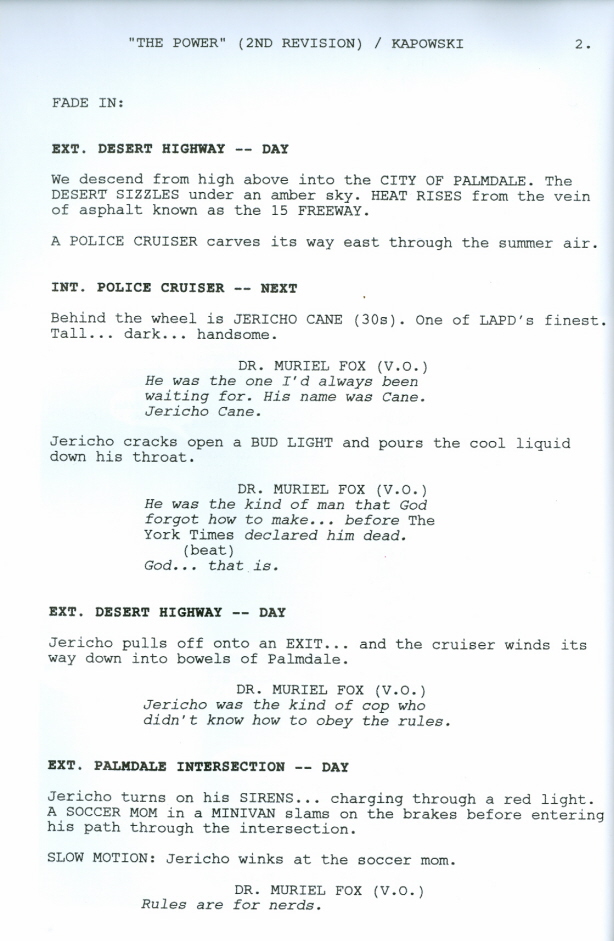
(If you don’t find that funny, this movie might be extremely painful for you.) Anyway, through a combination of subversive revolutionary action, plain accident, and assorted other Philip K. Dick-ian causes, the screenplay is being acted out in reality by people who don’t even know of it, as well as observed by all the other characters and by the actors themselves. Since the script is about the apocalypse, things get very strange in a hurry. Some neo-Marxists attempt to fake a shooting to turn the population of California against the government’s draconian anti-terror laws, instituted after two nuclear bombs exploded in Texas. Justin Timberlake plays a mutilated Iraq veteran who spends his days spying on (and occasionally killing) people from offshore through a giant rifle sight. He and several other characters have had megadoses of the mysterious Fluid Karma, a substance that causes telepathy, shared dreams, the mixture of fantasy and reality, and so on and so forth, like Chew-Z in Dick’s Three Stigmata of Palmer Eldritch. It’s also a clean fuel that will save the world, according to a bunch of German scientists led by Wallace Shawn. And at ground zero of this mess are a bunch of morons getting sucked into their own screenplay in the middle of Los Angeles, already shot, with the exception of one critical scene, to be apocalyptically unreal. I could go on and on, but you get the idea.

As these stars act out their wretched screenplay, it’s obvious that at least some of the badness of the acting, dialogue, and plot is intentional. But Kelly makes it impossible to separate the intentional from the unintentional, because the crap script mixes with “reality” to the point that they are inseparable, and none of the “real” characters are any smarter than their in-script standins. This is obvious early on, from the moment Krysta Now says “Apparently, the future is much more futuristic then scientists thought,” but also evident from the sheer lack of any empathetic characters. And I haven’t even mentioned the Justin Timberlake video embedded in the movie, done up as a tribute to The Big Lebowski. The movie is impressive in its self-referential textuality, as bad actors play bad actors writing bad screenplays with bad characters that they then become the bad stars of. (The Rock does a magnificent job of acting like he has no idea what’s going on.) Most of the cast are famous for anything but dramatic acting and can only be recognized as themselves, not as characters within a movie. This movie oozes Verfremdungseffekt.

If nothing else, these factors ensure Southland Tales a place in post-structuralist theory for years to come, a bitterly appropriate result. Still, that’s not to deny the disorienting effect the movie has in providing no reference point whatsoever to what would be called “real life.” It’s spectacle all the way down. But what spectacle! Kelly has given himself over to the pop culture overload and distilled it more densely, and authentically, than anyone since John Oswald. (The opening pastiche of news channel graphics, logos, and crawls is dead-on, the best anyone has done since Chris Morris’s Brass Eye.) And to Kelly’s credit, he never loses his grip, never sacrifices the miasma to anything that could dare be called “art,” which is why Cannes hated him and loved Tarantino. Even if Kelly was trying to elevate (quite literally, at points) his material, he never does.

So let’s go back to Kiss Me Deadly, which appears twice in the film and is clearly a major influence on Kelly. Aldrich’s film is a joke at everyone’s expense, a contemptuous reading of a Mike Hammer novel portraying Hammer as a dull-witted thug incapable of understanding the true stakes of what’s around him. Even the entire genre of detective novels is held up for ridicule when the McGuffin at the center of the story turns out to be anything but irrelevant. The acting ranges from lumpen to histrionic and never matches the unstable material. But unlike Southland Tales, it comes together to damn every bit of its source material and America with it. In Southland Tales, things are inverted: the fools understand and we do not, because the fools are generating their own story, and we–and I include director Kelly in that–are getting caught in it.

Hermann Broch: Geist und Zeitgeist

This essay was written in 1934: Broch is in Austria and Germany, the world is falling apart around him, and he places the blame on positivism? (He means it in the secularist sense, and he reserves special praise for the “unique sensitivity” of the Catholic Church.) I’m fond of Broch’s The Death of Virgil, but when it comes to ideas, his moral conservatism is limp and useless next to the work of Musil and Cassirer.

Faulkner’s Light in August and Coetzee’s Disgrace

Light in August is Faulkner’s longest book and certainly the most plainspoken of the early works, even more so than As I Lay Dying. I don’t think of Faulkner’s stream-of-consciousness techniques as being integral to his work in the way that experimental prose stylings are to Joyce or even Woolf, for they are always in the service of a a story–perhaps scrambled–that takes its expression in various ways. I see and feel less purely linguistic focus, and contrariwise, overwhelmingly strong thematic content that subordinates style and plot to its boundaries. That is to say, Faulkner is concertedly experimental in the same way that Melville is.

So because Light in August is about mostly sane and often simple people, it is very rare for any character save Joe Christmas to slip into Quentin Compson-ish mental chaos. Joe is rather crazy, and so his demons mix their words up:

thinking I dont even know that what they are saying to her is something that men do not say to a passing child believing I do not know yet that in the instant of sleep the eyelid closing prisons within the eye’s self her face demure, pensive; tragic, sad, and young; waiting, colored with all the vague and formless magic of young desire. That already there is something for love to feed upon: that sleeping I know now why I struck refraining that negro girl three years ago and that she must know it too and be proud, with waiting and pride

And for all this talk of Joe as Christ, it’s not particularly convincing. He continually runs away from himself and others. When he meets Joanna, who was brought up by abolitionists to feel damned by being white, he runs from her attempts to draw him into her own play of guilt and fatalism, but he fails and in turn rapes, lives with, and finally kills her.

Reading this again, I made a connection that I had never made before to Coetzee’s Disgrace. I often disagree with James Wood, but I think he was right in criticizing the novel for its historically overdetermined allegory:

Lucy’s “disgrace,” of course, is not one that she earned or deserved; but in pairing the two forms of penitence, the novel comes unpleasantly close to suggesting a formal parallel of disgrace, in which both characters enact “necessary” falls.

This is a significant weakness, and it returns us to Coetzee’s limitations, which are the limitations of allegory. Disgrace is so firmly plotted and shaped, so clearly blocked out, that it seems to request a kind of clarity of reading which is ultimately simplifying and harmful to the novel, in which “issues” are shared out between the generations, and split into willing binarisms: young and old, liberal and conservative, man and woman, straight and gay. Around this, the novel’s architecture attempts to fuse these binarisms, by arguing for a kind of parallelism. It as if the form of the book tells us that despite the oppositions of Lucy and her father, both characters share more than they divide, for here are two people undergoing their different-but-similar forms of disgrace.

And Lucy seems awfully close to Faulkner’s Joanna; she too takes the brunt of punishment directed at her historically and not personally, and Lucy too goes further in raising the child from her own rape.

Where I think Faulkner is stronger and does not fall into Coetzee’s hole is that he negates this inevitability, not with Lena’s child at the end, but with Joe himself, who is not black nor white, but takes on various identities over the course of the book at others’ insistence, only to be crushed by them over and over. The conclusive indication of this blank slateness is towards the end, before Joe is caught and lynched:

It is just dawn, daylight: that gray and lonely suspension filled with the peaceful and tentative waking of birds. The air, inbreathed, is like spring water. He breathes deep and slow, feeling with each breath himself diffuse in the neutral grayness, becoming one with loneliness and quiet that has never known fury or despair. ‘That was all I wanted,’ he thinks, in a quiet and slow amazement. ‘That was all, for thirty years. That didn’t seem to be a whole lot to ask in thirty years.’

Note: (1) the emphasis on “neutral grayness” and its non-racial implications; (2) organized thoughts presented as words rather than as italicized stream of consciousness; (3) the continuous emphasis of calm and peace, of nature in the absence of society; (4) the absence of any inner conflicting force. Joe’s demons are externally given by dint of situation, and in the brief moment that he feels left alone by all people and society, he gains peace. This is not to say that it is Joanna herself that assigns him his identity, but that Joanna is sewn in a determinate way into the social fabric in the way that Joe is not. People argue over whether Joe has “Negro blood” in him or not, but the whole point is that it doesn’t matter. Joe is put into situations where he purportedly does and doesn’t have it and it’s always for the worse. And the investigation of Joe’s situation and its indeterminacy (if I were being trendy, I would call it an aporia) is where Faulkner transcends Coetzee’s novel.

[I would say the same for Ralph Ellison, who extends this uncertainty into far greater territory in Invisible Man.]

J.M. Coetzee: Diary of a Bad Year

This is the third book in a series that began with Elizabeth Costello and continued with Slow Man. These books are fundamentally about being a writer who has won the Nobel Prize. Perhaps Coetzee keeps writing them because some people haven’t yet figured out that his fictional characters’ opinions are not his own; perhaps, as a writer already drowning in consciousness of tradition and context, he feels that these are the only sorts of books he can now write. I tell people when they read these books: remember that Coetzee has won the Nobel Prize, and think about what that means to him and what it means to people’s opinions of him. In having this title thrust on him, he is no longer any old author, but a certain sort of elder statesman. And being the sort of writer he is, he cannot let that stand unquestioned. And since academics are still using the animal rights sections in Elizabeth Costello as though they were freestanding philosophical essays, Coetzee takes further steps in Diary of a Bad Year to make it clear that the “philosophy” in the book is hardly meant to be taken seriously as philosophy. Out goes Elizabeth Costello; in comes J.C., a Nobel Prize winning South African novelist now living in Australia, just like Coetzee, except dumber.

The structure of the novel, in brief: several voices, those of a writer, J.C.; his amanuensis and crush, a cosmopolitan Filipina named Anya; Anya’s financier/scammer husband Alan; and most of all, the writings of J.C. as typed up by Anya. The writings are divided into two sections, one called “Strong Opinions,” written for some sort of German literary publication, and later on, “Soft Opinions,” written for Anya. Since these sections co-exist on each page, the book resists reading in an easy rhythm, as any attempt to read the three sections in parallel, especially early on, results in continual jarring shifts as the highfaluting tone of the “Strong Opinions” is undercut by J.C.’s earnest and vaguely creepy obsession with Anya and Anya’s own sardonic detachment. In some ways it comes as a respite, as the “Strong Opinions”–on the War on Terror, on torture, on intelligent design, and on other urgent political issues of the day–quickly become unbearably pompous, banal, and irritating. They are filled with cliched homilies familiar to anyone who has read the New York Review of Books in the last seven years and dilettantish excursions into areas that J.C. knows nothing about. I winced when reading his “opinion” on Guantanamo Bay that begins:

Someone should put together a ballet under the title Guantanamo, Guantanamo! A corps of prisoners, their ankles shackled together, thick felt mittens on their hands, muffs over their ears, black hoods over their heads, do the dances of the persecuted and desperate…In a corner, a man on stilts in a Donald Rumsfeld mask alternately writes at his lectern and dances ecstatic little jigs.

Had I read these opinions in a Philip Roth or John Updike book, I would take them at face value and discount the author accordingly. But Coetzee is too smart, and any comparison of the “Strong Opinions” to his real opinions in his thoughtful, careful essays makes the difference blindingly apparent. (It does take something approaching guts for a Nobel Laureate to write something so profoundly trite and irritating and attribute it to his own ostensible fictional proxy.) As with many literary intellectuals, J.C.’s excursions into math and science are particularly stupid. By the time J.C. writes, “I continue to find evolution by random mutation and natural selection not just unconvincing but preposterous as an account of how complex organisms come into being” and invokes Heisenberg without knowing what uncertainty even is, it’s obvious that Coetzee has no wish even to defend thes opinions; he is making them transparently foolish so that readers examine the rhetoric rather than the opinions. Underneath the sanctimonious white male liberal pablum, including defenses of pornography, Adorno-esque cultural snobbery in indictments of rock music, latent sexism (captured especially well, complete with tired attack on Catherine MacKinnon), and sympathy with enemies of whom he knows nothing, there bleeds the personality that is revealed in J.C.’s internal voice lower on the page. With most would-be political commentators in the literati, it is not quite so obvious, but in J.C., Coetzee gives us tools for easily making the connection.

For it is Anya who carries the voice objecting to the “Strong Opinions.” Alan picks up this critique later in a less sympathetic fashion, but it is Anya who connects J.C.’s emotional life with what he writes on the page. I felt great relief to hear her articulate my thoughts (and no doubt those of many other readers) when she politely tells J.C.:

OK. This may sound brutal, but it isn’t meant that way. There is a tone–I don’t know the best word to describe it–a tone that really turns people off. A know-it-all tone. Everything is cut and dried: I am the one with all the answers, here is how it is, don’t argue, it won’t get you anywhere. I know that isn’t how you are in real life, but that is how you come across, and it is not what you want. I wish you would cut it out. If you positively have to write about the world and how you see it, I wish you could find a better way.

So we lead to the real problem, which is J.C.’s impotence in the face of the current world horrors and the disastrous results of the obligation he feels to be relevant. As the book continues on and reveals J.C.’s ignorance of the world in several ways, Coetzee spares him little criticism, but does ultimately make a case for his real art in the form of the lovely, impressionistic “Soft Opinions,” short lyrical reflections in the last half of the book that mercifully replace the “Strong Opinions.” These vignettes are written with Anya in mind and with no attempt to be politically incisive. J.C. describes his dreams, his doubts, his age, his friends, and his passions, as antiquated and pedantic as they may be. Most of all, he makes no attempt to suppress the “I” out of the fear that he must pretend to be something he is not in order to address the world with urgency. There is some resignation in this shift, but also great relief; J.C.’s mask has fallen and he returns to himself. It puts him in correct proportion to the thoughtful but non-bookish Anya and her powerful but cowardly husband Alan, and the shift in tone allows him to have a visible, evident effect on Anya, one (it is implied) far greater than that of telling a bunch of would-be intellectual liberals what they already know and having them feel good about it because it’s coming from a Nobel Prize winner.

The affirmation ends in a paean to Dostoevsky. It is one of the most straightforward passages in any of Coetzee’s books, so heartfelt and elegant that it shames the “Strong Opinions” even further. Having achieved some rapprochement with Anya, J.C. stands in relation to Dostoevsky and his books and not to the world, leaving those connections to those more qualified to make them. And with this it becomes clear that those who will best appreciate these unpolitical, abstract thoughts are the ones who will read Diary of a Bad Year, and understand it, in the first place. William H. Gass came to a similar conclusion:

The contemporary American writer is in no way a part of the social and political scene. He is therefore not muzzled, for no one fears his bite; nor is he called upon to compose. Whatever work he does must proceed from a reckless inner need. The world does not beckon, nor does it greatly reward. This is not a boast or complaint. It is a fact. Serious writing must nowadays be done for the sake of the art. The condition I describe is not extraordinary. Certain scientists, philosophers, historians, and many mathematicians do the same, advancing their causes as they can. One must be satisfied with that.

William H. Gass

The theme of the writer’s relation to the world has dominated Coetzee’s post-Disgrace work, and many critics seem downright annoyed that he hasn’t produced another easily digestible and Important book like Disgrace. It would be too easy for Coetzee to do so. The narrowing of his territory may be starting to produce diminishing returns–this book is not nearly as eerie and vertiginous as Elizabeth Costello, though it is more consequential than Slow Man–but the earnestness with which Coetzee crawls over it and avoids easy answers is exemplary.

More on Gene Wolfe

Some good responses on my post on Gene Wolfe below. Just to be clear, I find plenty to mull over in Wolfe’s books, particularly with regard to his political and religious attitudes. What makes him so vexing is that I find his work substantively disappointing and yet cannot dismiss him. But I maintain that there’s an attitude brought to the work that makes the books less than they could be, and indeed, what I think Wolfe wants them to be. Some quotes:

LM: All this “showing” in “V.R.T.” is made intriguingly ambiguous by the confusion about who “Marsch” really is.

Wolfe: In the end, of course, it’s important that the reader not be confused about this, although part of the fun is supposed to be figuring out what’s happened. I leave a number of clues as to who the narrator actually is. For example, both V.R.T. and the narrator are shown to be very poor shots, whereas Marsch is a very good shot, and there’s other hints like that. If you hire a shape changer as a guide, there’s a definite possibility that he’s going to change into your shape at some point. Which is what happens.

Larry McCaffery interview

JJ: The Soldier of Arete is even more than
Soldier of the Mist a bit
hard to follow in terms of his plot. And I remember, in fact I
remember when it came out Orson Scott Card really complained that
(it was in Analog or Astounding; one of those magazines) he had a
review that said “Nobody reads Gene Wolfe with more care and
affection than I do but I can’t figure out what this book is about.”
What is wrong with this author? Does that kind of complaint
bother you or do you feel as if you wish you could leave more clues
or do you feel: Hey, read the book and look at it again and you
will find the answers.

Wolfe: I try not to leave a clue more than once. It bothers me a lot
when it is left more than once in somebody else’s book. If you told
me once that the hero is left handed, I have registered it or at
least I hope I have registered it or whatever this may be and if
you told me five times then I feel that you are writing to somebody
that is a lot dumber than I am. So I try and leave my clues once
and generally try and leave all the clues that I think the reader
is going to require, sometimes more than they require because you
don’t generally find situations in which you have exactly as much
information as you need to solve the thing. If it is solvable at
all you probably have more. If you have only a very few items then
it probably isn’t solvable with the information that you have. What
you need to do in a real life situation is to go out and get more
clues. If you know anything about actual police work very little of
it consists of reasoning from clues and the great majority or it
consists of finding more clues. Because when you have found enough
then you have got, you have very little difficulty in understanding
what they mean.

James B. Jordan interview

This talk of clues and confusion makes me suspect that yes, Wolfe does expect the reader to figure it out, and that the lacunae in his work are not meant to sustain indeterminacy, but to provide a framework for the reader to explore in search of answers. And since I am not the sort of person who remembers that a character is left-handed two hundred pages later, I find it frustrating, for example, that it would greatly aid my understanding of the book to realize that two characters with different names are actually one and the same by virtue of their handedness. This is just not what I read fiction for.

I did not consider this a problem in “V.R.T.,” where the crucial narrative trick is fairly obvious once you know what to look for. And, as Wolfe says, discovering this trick is necessary to understand the story. But by The Book of the New Sun, the elisions have multiplied beyond what I can manage, and I cannot convince myself that I can ignore them.

Now, I can enjoy Ulysses and draw much from it without knowing whether or not Bloom gives a condom to Alec Bannon at the impenetrable end of chapter 14. Unlike Joyce, Wolfe stakes so much of his book on these sorts of narrative obscurities that (a) in the absence of their resolution, the book does not reveal itself sufficiently, and (b) Wolfe subordinates thematic and conceptual integrity to the mere challenge of these games. Many people are content to enjoy the ride and pass over these issues, and Wolfe deserves the attention they give him, but this is not enough for Wolfe to satisfy his books’ ambitions.

[Special thanks to Spurious for articulating some of these issues better than I could. He brings up the even more perplexing subject of the correspondence or lack thereof to Christian deity and eschatology, then concludes that the book is sane. I agree, but I prefer a different phrasing. Wolfe was an industrial engineer by training and profession, and as with much science-fiction, a particular sort of engineer’s attitude goes into the functional and architectural construction of his work, and these attitudes are reflected in the methodologies of Severian and Silk. Like many of his characters, Wolfe’s books are machines, and it is only when looking for the animating spirit that one runs into trouble with them.]

« Older posts Newer posts »

© 2026 Waggish

Theme by Anders NorenUp ↑