I don’t usually write about bad books because there’s little point to it, even if they’re popular. (This is why you don’t see me complaining about such important contemporary writers like M_______ or F_______ or L________.) But sometimes I read a book where the badness is illustrative or at least interesting, and Aira’s Ghosts is one of them. Aira writes short books with endorsements from Roberto Bolano. Here is a bit from one of his dips into philosophical musing in Ghosts:
She dreamed of the building on top of which she was sleeping, not as it would be later on, not seeing it finished and inhabited, but as it was now, that is, under construction. It was a calm vision, devoid of troubling portents or inventions, almost a verification of the facts. But there is always a difference between dreams and reality, which becomes clearer as the superficial contrast diminishes. The difference in this case was reflected in the architecture, which is, in itself, a reciprocal mirroring of what has already been built and what will be built eventually. The all-important bridge between the two reflections was provided by a third term: the unbuilt.
The architectural reflections go on, but this is enough. On first glance it may read well, but the longer you look at it, the more incoherent it seems. I do not think this is the fault of translator Chris Andrews, whose translations of Bolano had no such issues. How is a vision a “verification of the facts”? If the superficial contrast between dreams and reality is not the important difference, what is it in the general case, not just for this building? Why does the architecture “mirror” the built and the unbuilt? Why is the mirroring reciprocal? How does one bridge two reflections?
Such elisions would not be capital offenses if they didn’t point to such a sloppiness on Aira’s part, as though he were writing more quickly than I read. (He publishes 2-4 books a year, so perhaps he does.) Skewing concepts toward surrealism can be effective, but with Aira, that impression is merely an unpleasant side effect of a quick, lazy attempt at profundity. The ensuing reflections on “the unbuilt” also fail to cohere for the same reasons: Aira hasn’t spent enough time thinking things through.
Because rigor and precision are not traits that are greatly valued in fiction (not now and probably not ever–even now it is rare to see Musil elevated above Mann and Broch as the sharpest thinker of the three by far), there’s little context in which to criticize Aira’s faults. His flashy collisions of ideas give the book credibility as fine literature, but in the race to write, publish, read, review, and ultimately forget about books, no one seems to have stood back and said that the ideas are inchoate, secondhand, and lacking.
For contrast, I was just reading some stories by Mario Benedetti. They don’t shoot for highbrow philosophy, but the writing is sharp, and the ideas are, as a philosopher said, clear and distinct.
I think that Blumenberg is much more positive about the modern age than you suggest. Indeed, one might even compare his remarks on science – particularly its institutionalisation of method – with those of Popper. Popper of course would have no time for myth, but Blumenberg’s genius was to have shown that myth too can be defended in a similar way to science. The never ending variation that is the history of myth’s rewriting is comparable to the infinite progress that is the fate – and the triumph – of modern science.
I agree with this and I didn’t mean to give the impression that Blumenberg is a pessimist. In fact, Blumenberg’s ire seems reserved for those conservative pessimists like Schmitt, Loewith, or even Voltaire, who define the present moment as a crisis and look back to the past to try to find some point where we went wrong. He has even less patience for those, from Epicurus to the Gnostics to Kierkegaard, who ask that we should turn our back on the world and seek some private, otherworldly transcendence. And I do believe that Blumenberg’s endorsement of curiosity, science, and a secular interest in improving the world amounts to a prescription for a pragmatic progress: the right for humanity to explore, experiment, err, and positively evolve.
It is so optimistic, in fact, that it is difficult for me to accept enthusiastically. If I believe that a humanistic science offers the best way forward for the people on this planet, it’s only because I can’t think of any better ideas, not because I am filled with hope that things will work out. Blumenberg is more of a believer, and the faith he holds seems best portrayed in Blumenberg’s touching portrait of Husserl:
Scarcely a decade after theory, as mere gaping at what is ‘present at hand,’ had been, if not yet despised, still portrayed as a stale recapitulation of the content of living involvements, it was the greatness of the solitary, aged Edmund Husserl, academically exiled and silenced, that he held fast to the resolution to engage in theory as the initial act of European humanity and as a corrective for its most terrible deviation, and that he required of it a rigorous consistency, which is still, or once again, felt to be objectionable. Hermann Lübbe has described as the characteristic mark of this philosophizing, especially in the late works, the “rationalism of theory’s interest in what is without interest”: The existential problem of a scholar who in his old age was forbidden to set foot in the place where he carried on his research and teaching never shows through, and even the back of the official notice that informed him of this prohibition was covered by Husserl with philosophical notes. That is a case of ‘carrying on’ whose dignity equals that of the sentence, ‘Noli turbare circulos meos’ [Don’t disturb my circles].”
The Legitimacy of the Modern Age, III.Introduction
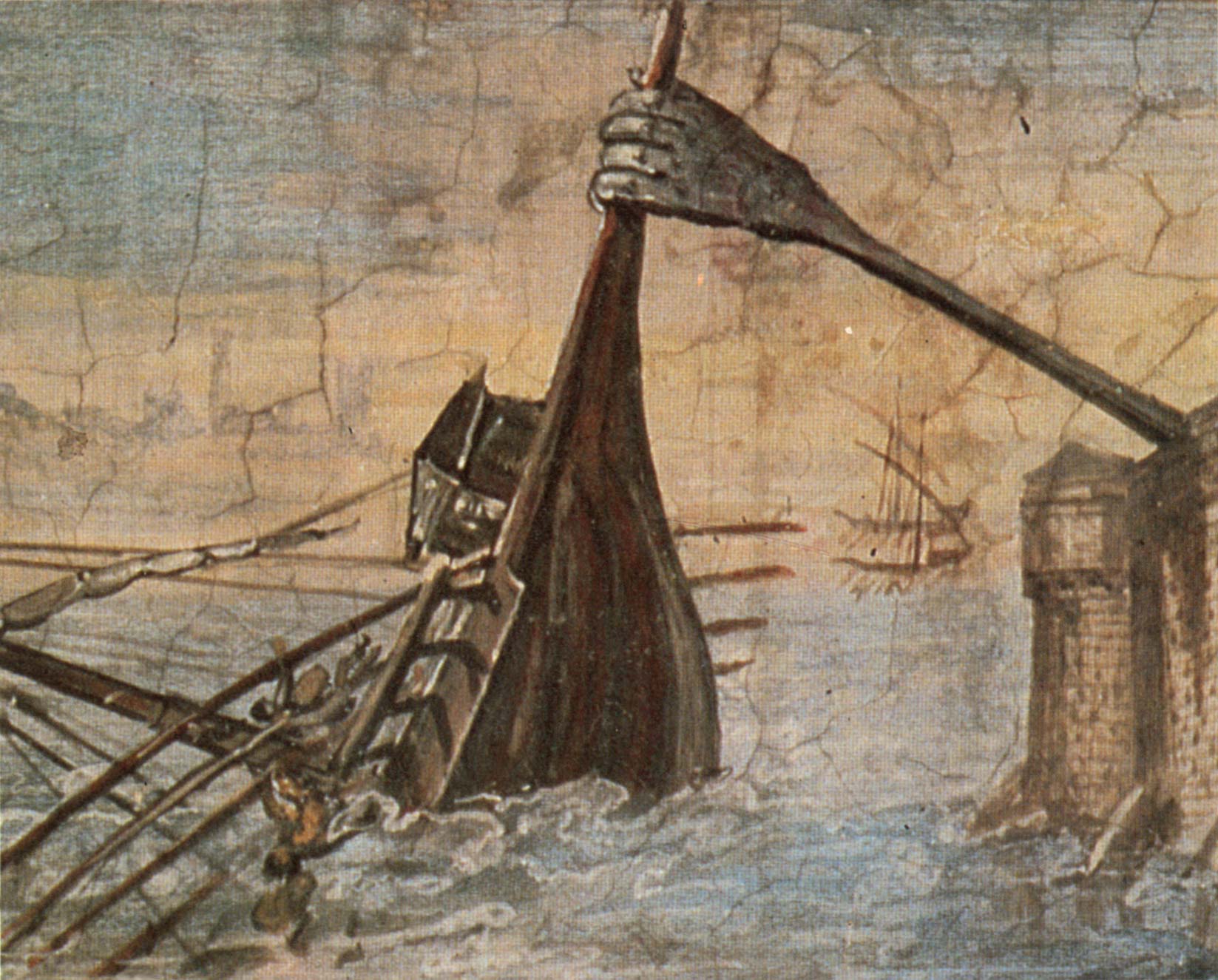
Let’s leave aside that Archimedes, in addition to being killed while working on theoretical math, had also designed warships and this claw:
The ideal here is that of a scholar who can retain his absorption in theory even as the surrounding chaos nearly envelops him. Here, for Blumenberg, it is theory that acts as the linking and growing mechanism of humanity. (And as commenter Durkheim suggests, theory is something of a halfway point between myth and science.) The danger is, of course, that theory turn into something as private as Gnosticism. What is it that gives Blumenberg and Husserl the assurance that they have not disappeared into a private fount of knowledge irrelevant to the greater world? This is a crucial question for Blumenberg to answer in the context of the book. I think that the answer, which is hinted at above, is that there needs to remain some sort of firm method, that “rigorous consistency” that Blumenberg mentions: the placing of the external world as authority and arbiter rather than one’s own self-certainty. (Here, Blumenberg separates from Hegel and moves back to Kant.) Again, I see this as a pragmatic methodology more than anything else, except that there was no such named tradition in Germany.
The other somewhat orthogonal point is how Blumenberg contrasts Husserl with Heidegger, who goes unnamed but is sniped at as the person who attacks Husserl’s theory as “gaping at what is ‘present at hand'”. Blumenberg implicitly connects Heidegger’s political beliefs with Heidegger’s priority of the “at hand” and activity over cognition and observation. Heidegger’s political associates bar Husserl from the library at which he studied. Heidegger removes the dedication to Husserl from Being and Time. Husserl stands back. He keeps working. And Husserl remains one of the least alluring, least sexy philosophers ever. He never cheats, he is never cheap, he is never glamorous. (Even his glamorous successors–Derrida and Sartre–did not put a shine on him.) He just keeps working things out.
I don’t want to enter that eternal debate on Heidegger, but I do sympathize with the emphasis Blumenberg places on detached observation, on the classical act of thinking and theorizing that still seems to have gone missing amidst unending talk of politics, subversion, performativity, and so on. (To those who say that detached observation is a luxury, the subsequent activities are no less luxuries.)
When I quoted Satie the other day (apparently an appropriate quote, thank you Dennis), it was this contrast between theory and action that I was thinking of: youth in action, old age in reflection. As every development in culture and technology (hello, the web) rushes to celebrate and analyze itself before it has barely begun to be anything at all, the nonstop circle of activity exhausts me, and I want to be the rigorous, consistent theorist myself:
Deeply lost in the night. Just as one sometimes lowers one’s head to reflect, thus to be utterly lost in the night. All around people are asleep. It’s just play acting, and innocent self-deception, that they sleep in houses, in safe beds, under a safe roof, stretched out or curled up on mattresses, in sheets, under blankets; in reality they have flocked together as they had once upon a time and again later in a deserted region, a camp in the open, a countless number of men, an army, a people, under a cold sky on cold earth, collapsed where once they had stood, forehead pressed on the arm, face to the ground, breathing quietly. And you are watching, are one of the watchmen, you find the next one by brandishing a burning stick from the brushwood pile beside you. Why are you watching? Someone must watch, it is said. Someone must be there.
That is the opening to Hiroshi Teshigahara’sThe Man Without a Map, better known in its English novel translation as The Ruined Map. The amazing cutup music is by Toru Takemitsu.
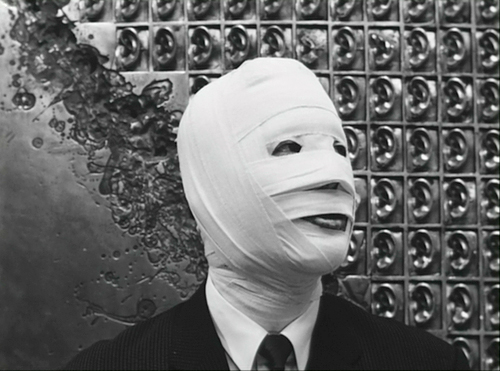
It’s the final of four collaborations between Teshigahara and novelist/screenwriter Kobo Abe, who also produced the gorgeous The Woman in the Dunes and the surreal and disturbing The Face of Another. If there’s a problem I have with those two, it’s that Teshigahara always seems to be the sanest of the contributors: while Takemitsu and Abe are straining at the margins of convention, Teshigahara seems more content to play things straight, filming things as though they were conventional dramas with haunting scenery. I don’t think it’s coincidence that Teshigahara’s last film was about a master of tea ceremonies.
In The Man Without a Map everything falls apart. The movie isn’t a disaster and has enough to hold interest, but it is a failure. Teshigahara seems uninterested in the material and gives it little visual flair, while the ambiguities of the earlier films now spill into incoherence. The basic story is of a detective hired to investigate a missing man, Nimuro, by Nimuro’s sister. But the noir tropes dissolve as quickly as they’re introduced. Nimuro’s brother shows up to give the detective secret information that the sister did not reveal. Nimuro’s wife appears and disappears. Nimuro was involved with some bootleg food stalls possibly associated with the mafia, who beat up the detective. A man tempts the detective with nude photos he claims were taken by the Nimuro, but were they? Do they have anything to do with Nimuro?
That last mysterious man, who throws out clues that may be red herrings, who may not be related to the case at all, is the closest to the heart of the movie. The detective is hostile to any sort of conventionality, and by the end of the film, the noir tropes appear to be springing up because he wills them to do so, even if they don’t make sense. By the end of the movie (spoiler alert!), the mystery man announces his attention to commit suicide on the phone to the detective, who is annoyed with him and ready to hang up. The detective asks if he’s written a note: “No. They’re not exactly easy to write.”
I laughed, but I take it to mean that in trying to write some sort of lives for themselves outside the margins, Nimuro, the detective, and the mystery man have unwoven the fabric of their lives and so they fall apart, like the movie. Similar disintegrations happened in the earlier films by Teshigahara and Abe, but they didn’t reach the level of the plot, as they do here. Because, it appears, Teshigahara is not on board with Abe’s conceit, the film falls apart as it attempts to fall apart.
It makes me wonder what would have happened if a more avant-garde filmmaker of the time like Terayama, Oshima, or Yoshida had worked with Abe’s material–this or Abe’s far crazier The Box Man, where Abe abandons all pretense to psychological realism. The Face of Another is the most successful of their collaborations because Teshigahara is able to transform a “normal” world into one that becomes increasingly frightening and chaotic for the faceless protagonist. But once the normal is far out of sight, visual innovation has to substitute for the normal reference points of identification, and in The Man Without a Map, it doesn’t happen.
And just to conclude, here is the trailer for The Woman in the Dunes, featuring Takemitsu’s eerie, remarkable electroacoustic score:
Williams wrote the serious, affecting academic novel Stoner before he wrote this (mostly) epistolary novel about Augustus Caesar. Despite Williams’ protestations that both novels are concerned with power, the poor academic Stoner had no power while the characters in this one have nothing but. Augustus himself does not speak until the short, final section. The rest of the novel is told in letters between his family, friends, and a few enemies (Cicero and Mark Antony).
Williams ignores the influence of Robert Graves’s salacious Claudius novels and most of the dicier gossip of the time. It is a very high-minded and “Greek” treatment of the Romans. Augustus’ wife Livia is not the murderous witch of the Graves books, merely tough-minded and manipulative, though Augustus sees right through her. In parts Williams goes out of his way to avoid the pettier emotions: Augustus sentences his daughter Julia to a brutal island exile in order to save her life, not to punish her for treason. Augustus is also not concerned with her promiscuity or with promiscuity in general; his draconian marriage laws are merely to promulgate virtue, not demand it. This Augustus is, if anything, closest to the spectral Augustus of The Death of Virgil, who is more a philosophical respondent to Virgil than an actual person. Williams’s Augustus even expresses regret for exiling Ovid.
So Augustus emerges as a preternaturally calm and clear-headed person, as close to the ideal of the enlightened monarch as one could hope. Before his ascent, in the first half of the book, he is a cold, masterful tactician. After becoming emperor, he is a stoic ruler resigned to the unhappiness and isolation that he has brought on himself and pessimistic that the tide of chaos can be fought off after his death. This dialogue with Julia, after he has chosen Tiberius reluctantly but mindfully as his underwhelming successor, is representative:
“Father,” I asked, “has it been worth it? Your authority, this Rome that you have saved, this Rome that you have built? Has it been worth all that you have had to do?”
My father looked at me for a long time, and then he looked away. “I must believe that it has,” he said. “We both must believe that it has.”
Here, as elsewhere, he is more Marcus Aurelius than Augustus.
The things that get out of Augustus’s control do not do so because of human fallibility and weakness, at least not on Augustus’s part. In his final monologue, he expresses little but resignation for what he has accomplished, and he regrets the loss of friendship and ordinary life that his position has cost him. These are the strongest moments in the book, the contrast between the benevolent despot and the young genius among his talented friends and compatriots, the last time he knew actual friendship.
In contrast, the weak point is Julia. Williams seems to have made a conscious decision to give Julia a long and retrospective part in the book, writing her memoirs after Augustus’s death on a larger and less wretched island than the original site of her exile. She writes as a mature, disappointed woman who holds little anger, someone who has lost whatever power she once had. She is happy, but Williams does not succeed in defining her sufficiently to make her more than a foil for Augustus. Perhaps this is a result of the paradox he set himself: Julia and Augustus cannot engage in a real dialogue over the course of the book because they are inhabiting different worlds. Williams does better in having other characters describe their relationships with Augustus, because among all his generals and advisers there is mutual understanding among the intrigue and mistrust, and so they all feel imminently present and evoke how Augustus is always at a remove, even when speaking for himself.
What is its relation to Stoner, which portrays little but small spiritual triumph in an unromanticized academic life? The pains and losses in Augustus are so large as to overwhelm most of the “human” motivations that drive Stoner (as well as most novels). The book reads something like a thought experiment: if Augustus had been so reflective and benevolent, how could the events of his life be explained? What results is an old masters portrait of Augustus, larger than life and larger than human emotion, but still in touch with both.
It seemed to K. as if at last those people had broken off all relations with him, and as if now in reality he were freer than he had ever been, and at liberty to wait here in this place, usually forbidden to him, as long as he desired, and had won a freedom such as hardly anybody else had ever succeeded in winning, and as if nobody could dare to touch him or drive him away, or even speak to him; but –this conviction was at least equally strong—as if at the same time there was nothing more senseless, nothing more hopeless, than this freedom, this waiting, this inviolability.
The Castle
It’s not all “Before the Law” and “The Judgment.” Especially in The Castle, K. has his moments of self-determination and freedom beyond anything typically associated with Kafka. It’s still problematic–and then some!–but it’s not the man waiting for the law, and it’s not the country doctor in bed with the patient. It’s as if Josef K. had not been killed at the end of The Trial but was allowed to stay in the open air (I believe the only time in the whole novel in which he is definitively outdoors).
[A scene from the odd but effective Japanese animation of “A Country Doctor.”]