Sviatoslav Richter: Musical Strict Constructionist

It is at once ridiculous and absolutely fitting that Richter was an originalist (i.e., a believer in the original intent of the composer) in his views on music:

Following an absolutely frightful concert that I gave at the Fetes Musicales de Touraine, when I played eight of Liszt's Transcendental Studies, and a recital in Japan, where I took fright even before launching into Beethoven's Op. 106 Sonata, I made up my mind never again to play without a score.

It any case, what's the point of cluttering up your brain when there are far better things to do? It's bad for your health, and it also smacks of vanity. True, it's not as easy to retain the same degree of freedom with a score open in front of you - it doesn't work straight away and requires a lot of practice - but now that I've got used to it, I find that it has lots of advantages. In the first place, I've never made any distinction between chamber music and music written for a solo performer. But one always plays chamber music with a score; why should one have to perform without one as a soloist? In the second place, it's easy enough to memorize a Haydn sonata, but I prefer to play twenty while reading the music, rather than limiting myself to two performed from memory. As for contemporary music, there are only a few exceptional artists who are able to memorize a piece by Webern, or Hindemith's Ludus tonalis, but it's a waste of time and effort. It's not *practical*. Moreover, even if the element of danger and risk aren't totally foreign to music, you feel more secure and can concentrate better if you've got the score in front of you. Finally, and above all, it's more honest to play like this: you've got how it has to be in front of you and you play exactly what's written. The interpreter is a mirror, and performing music doesn't mean contaminating the piece with your own personality, it consists in performing *all* the music, nothing more and nothing less. Who could ever remember *all* the performance markings indicated by the composer? Failing that, performers start to 'interpret', and it's that that I'm against.

By freeing the brain of the useless task of memorizing the music, you can also stop inflicting the same endlessly repeated programmes on audiences - and on yourself.

(from Bruno Monsaingeon, Sviatoslav Richter: Notebooks and Conversations, tr. Stewart Spencer)

This also makes him a Romantic Hermeneut (diagram c/o this link):
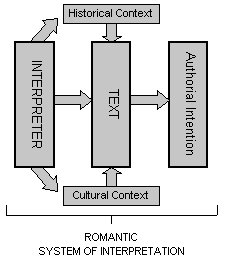
Except without those messy contexts:

The interpreter is really an executant, carrying out the composer's intentions to the letter. He doesn't add anything that isn't already in the work. If he's talented, he allows us to glimpse the truth of the work that is in itself a thing of genius and that is reflected in him. He shouldn't dominate the music, but should dissolve into it. I don't think that my way of playing has ever changed. Or if it has, I didn't notice, Perhaps I simply started to play with greater freedom as I threw off the shackles of existence and rejected the superfluous and all that distracts us from the essential. It is by shutting myself away that I've found freedom.

I might have had doubts about the extent to which I managed to play what I intended, but from the beginning I was always certain that, for each work, it was in this way, and no other, that it had to be played. Why? It's very simple: because I looked closely at the score. That's all that's required to reflect what it contains.

Kurt Sanderling once said of me: "Not only can he play well, he can also read music." That wasn't such a bad way of putting it.

This is, of course, insane, but who am I to question the ethos given the results? Likewise with Sun Ra and Anthony Braxton, two of the more articulate eccentric musical wonders of the age.

30 March 2007, 14:20 |

Comment

  1. Maybe worth a footnote to add that when Sun Ra was teaching the Arkestra to play the old swing standards of Fletcher Henderson and Jimmy Lunceford, he told them not to just copy them or to play what was written, but to express the composer’s original intention and purpose for the piece.

    — mrG · Mar 31, 10:15 AM · #

  2. Wow, who would have thought? Thanks for mentioning it. Now, I wonder what he said about those Disney tunes…

    I also have to wonder about Braxton, given his unorthodox treatment of standards. From Dorward’s review:

    “There are “free” tracks on here, but many of the tracks are faithful enough to bebop convention that you can’t help comparing them to “competent” bebop performances – from which perspective the playing here is often perfectly frightful.”

    — Mr. Waggish · Mar 31, 11:42 AM · #

  3. Two of my favorite recordings are of Bach’s The Well-Tempered Clavier as performed by Richter and by Gould. Their hermeneutics are at odds with one another (if Richter’s Scalia, is Gould Breyer? and did the earth move?) and the results seem inconsistent with the stances. But then, even what constitutes proper tuning is at issue. cf

    http://www-personal.umich.edu/~bpl/larips/bachtemps.html

    — nnyhav · Apr 7, 01:46 PM · #

Textile Help

On Formalism: 5 Films   |   Albert O. Hirschman: Exit, Voice, and Loyalty


Search


Mail Waggish
RSS | Atom

MetaxuCafe

100 Most Recent Essays
  • Donald Philip Verene: Knowledge of Things Actual And Divine
  • Southland Tales
  • Faulkner's Light in August and Coetzee's Disgrace
  • J.M. Coetzee: Diary of a Bad Year
  • Ernst Cassirer on Art Public and Private
  • P.F. Strawson: Freedom and Resentment
  • More on Gene Wolfe
  • Harry Partch: Delusion of the Fury
  • Gene Wolfe: The Book of the New Sun
  • Richard Hughes: A High Wind in Jamaica
  • Sellars on Following a Rule
  • Robert Walser: The Assistant
  • Occurrences at Owl Creek Bridge: Beyond the Zeroes
  • Carol Polsgrove on Ralph Ellison
  • Grondin on Gadamer
  • Occurrences at Owl Creek Bridge
  • Richard Rorty: Philosophy and the Mirror of Nature
  • Richard Rorty, 1931-2007
  • Jerry Fodor on Galen Strawson on Consciousness
  • Gadamer on Hegel and Language
  • Roberto Bolaño: Amulet
  • Hegel and Wittgenstein
  • Roberto Bolaño: The Savage Detectives
  • The Fall and Romanticism
  • Albert O. Hirschman: Exit, Voice, and Loyalty
  • Cesar Aira: An Episode in the Life of a Landscape Painter
  • Hegel's Conservatism (and McGoohan's Too)
  • Vladimir Sorokin: Ice
  • The Basic Conservatism of Hegel
  • Hegel and Stoicism
  • Kafka: Diogenes
  • Choose Your Own Philosophical Adventure #1: Escape from the Dialectic
  • Miklos Jancso: The Lord's Lantern in Budapest
  • Miklos Jancso: God Walks Backwards
  • Miklos Jancso: Winter Wind (Sirokko)
  • Fun with Consciousness
  • Magdalena Tulli: Moving Parts
  • Hugo von Hofmannsthal: An Incident...
  • Joanna Russ: We Who Are About To... [Die]
  • Finnegans Wake: The Book of Lists
  • Ecumenicality
  • David B.: Two Stories
  • What's Missing from Finnegans Wake
  • Laszlo Krasznahorkai: War and War
  • The Fifth Horseman is Fear
  • Christopher Priest: The Affirmation
  • Inquest on Left-Brained Literature
  • More Books on the (Finnegans) Wake
  • Carl Schmitt
  • Shohei Imamura 1926-2006
  • The Books on the (Finnegans) Wake
  • Gnostic Children's Books
  • Finnegans Wake and Little, Big
  • Reflections in/on Finnegans Wake
  • Godard: Masculin-Feminin
  • Dino Buzzati: The Tartar Steppe
  • Ilya Khrzhanovsky: 4 (Chetyre)
  • Stanislaw Lem (1921-2006)
  • Anne Stevenson: In the Museum of Floating Bodies and Flammable Souls
  • Hiroshi Teshigahara: The Face of Another
  • Samuel Beckett: How It Is & Ping
  • Elaine May: A New Leaf
  • Bela Tarr: Satantango [3]
  • J.M. Coetzee: Slow Man
  • Harold Brodkey
  • Bela Tarr: Satantango [2]
  • Bela Tarr: Satantango
  • Gabriel Josipovici: In a Hotel Garden
  • Erich Auerbach: Mimesis 1
  • Samuel Delany: The Motion of Light in Water
  • Yasunari Kawabata: The Sound of the Mountain
  • Keiho Oguri: Sting of Death
  • Aleksandr Sokurov: The Sun
  • Samuel Beckett: Watt
  • Au Fin Du Temps Perdu
  • John Crowley: Great Work of Time
  • David Grossman: See Under: Love
  • Alain Resnais: Night and Fog
  • Albert O. Hirschman: The Passions and the Interests
  • Denis Diderot: Rameau's Nephew
  • Gabriel Josipovici on Grimm and Kleist
  • Shaviro on Schumpeter
  • Thoughts on Genre: Blogs and Practice
  • Thoughts on Genre: Blogs and Improvisation
  • Thoughts on Genre: Blogs and Genre
  • Thomas Bernhard: Extinction
  • Strawson on Consciousness
  • Thoughts on Genre: Hitsville, Dullsville
  • Thoughts on Genre: Exceptional Science Fiction
  • Thoughts on Genre: The Secret of Comedy (circa 1935)
  • J.M. Coetzee: Elizabeth Costello
  • Thoughts on Work
  • Jean Eustache: The Mother and the Whore
  • Brett Bourbon: Finding a Replacement for the Soul, cont.
  • Adolescence
  • Jacques Becker
  • Brett Bourbon: Finding a Replacement for the Soul, cont.
  • Brett Bourbon: Finding a Replacement for the Soul
  • Kira Muratova: The Asthenic Syndrome
  • Correspondence vs. Metaphysics

Work in Progress
  • Waggish Reads Proust
  • The Novel: 206,000 (first draft finished)

Comment
  • Fraser Hawkins (More on Gene Wolfe)
  • Dave (Donald Philip Verene: Philosophical Rhetoric)
  • ethan carter (Southland Tales)
  • Mr. Waggish (Literature Minus One)
  • Pauljo (Literature Minus One)
  • kevin (Literature Minus One)
  • phoenix complex (Literature Minus One)
  • nnyhav (Literature Minus One)
Please Read
  • Cahiers de Corey
  • charlotte street
  • Chekhov's Mistress
  • Complete Review
  • Dispatches from Zembla
  • Eudaemonist
  • Even Unto Thy Shoes
  • The Existence Machine
  • Flowerville
  • Fortunes of the Dialectic
  • Geegaw
  • Gentle Reader
  • Golden Rule Jones
  • Le Colonel Chabert
  • Mumpsimus
  • Nightspore
  • pas au-dela
  • Pseudopodium
  • The Reading Experience
  • ReadySteadyBook
  • scarecrow
  • snarkout
  • Spurious
  • Stochastic Bookmark
  • Tabula Rasa
  • This Public Address
  • This Space
  • Three-Toed Sloth
  • With Hidden Noise
  • wood s lot

Credits
  • Banner by David B
  • Design by geegaw
  • CSS by snarkout
  • CMS by Textpattern

Archives
  • January 2003
  • February 2003
  • March 2003
  • April 2003
  • May 2003
  • June 2003
  • September 2003
  • October 2003
  • November 2003
  • December 2003
  • January 2004
  • February 2004
  • March 2004
  • April 2004
  • June 2004
  • September 2004
  • October 2004
  • November 2004
  • December 2004
  • January 2005
  • February 2005
  • March 2005
  • April 2005
  • May 2005
  • June 2005
  • July 2005
  • August 2005
  • September 2005
  • October 2005
  • November 2005
  • December 2005
  • January 2006
  • February 2006
  • March 2006
  • April 2006
  • May 2006
  • June 2006
  • July 2006
  • August 2006
  • September 2006
  • October 2006
  • November 2006
  • December 2006
  • January 2007
  • February 2007
  • March 2007
  • April 2007
  • May 2007
  • June 2007
  • July 2007
  • August 2007
  • September 2007
  • October 2007
  • November 2007
  • December 2007
  • January 2008
  • February 2008
  • March 2008
  • April 2008
  • May 2008