Waggish

David Auerbach on literature, tech, film, etc.

Category: Essays (page 37 of 46)

Nagisa Oshima and Other Japanese New Wave Films

There have been two retrospectives of Oshima recently in New York, as well as a brief New Wave overview at the Japan Society. Most of these films aren’t readily available, and for Oshima at least, people’s opinions of him have been skewed by only watching his late work, particularly In the Realm of the Senses (which is really not my thing). So here are quick takes on what I’ve seen. First, three early Oshima films.

The Sun’s Burial (Oshima, 1960): Assorted gang members and other lowlifes in Osaka try to make money and kill each other. Even here, though, Oshima is not concerned with realism. The film is essentially a melodrama and the plot contrivances are designed to generate theatricality and brutality. Oshima is technically fluent, but the film’s construction pales next to Imamura’s contemporaneous Pigs and Battleships, which takes a more anthropological view toward its lower-class subjects.

Night and Fog in Japan (Oshima, 1960): At a wedding, students, professors, and activists argue over what happened during the student movement against the Japan-America security treaty ten years earlier. There’s a lot of political talk without much background, but the depiction of a dead-serious Communist student movement, complete with censure and autocracy, is compelling. The flashbacks and camera movements are vaguely dialectical (the camera has a habit of swinging horizontally backwards and forwards), and it’s clear that the political content is meant seriously, not satirically, even if Oshima is ultimately pessimistic about the movements and their hollow leaders. It’s a more literal version of what Godard did in La Chinoise.

Pleasures of the Flesh (Oshima, 1963): Based on a book apparently entitled Pleasures of the Coffin, this is another over-the-top melodrama. Our hero murders a man who raped the teenage object of his obsession/love/lust, then comes into a fortune through hard-to-figure circumstances. He spends a year spending money by hiring assorted women as prostitutes. Things go very badly. The material seems to be tongue-in-cheek, but the rampant misogyny (the women just want money, they betray him, they don’t have feelings, etc.) is still hard to take. Best example of such: our hero secretly watches a pimp rape his prostitute, but doesn’t intervene until the pimp is about to pour acid on her face. Yeah.
Bessie Head: A Question of Power

I own a first edition of this book (thank you Roanoke City Public Library), and though it has an excellent cover painting which is strikingly apt, the jacket text and two blurbs (by Alice Walker and Nikki Giovanni) are terrible at giving any idea of what the book is actually about. The jacket text makes it out to be an uplifting work of social realism, while the blurbers are just vague. What they all avoid mentioning is that the book’s main character, a half-white/half-black South African single mother refugee in Botswana (as Head herself was), is schizophrenic and her hallucinations make up at least half of the novel. The hallucinations evade easy explanation as well as specificity; their achievement is to make A Question of Power transcend any easy classification as an “African” or “feminist” novel while still dealing with those very issues in specific terms. The hallucinations keep the book expansive and confounding.

The book is divided into halves called “Sello” and “Dan,” named for the main hallucinated figure during that section. Nonetheless, each appears in each other’s section, there is a much larger cast of characters, and “Sello” and “Dan” do not fall into any easy opposition. Each section alternates between these hallucinations and short, controlled descriptions of real life encounters between the main character, Elizabeth, and the others in her farming village, both natives and Peace Corps workers. Again, there are no blatant parallels. Elizabeth’s alienation from her surroundings, her race, her son, and men manifest themselves in the hallucinations, but so do less personal issues of human mythology (Buddha makes a few appearances), good and evil, gnosticism, and other things.

Of the two main visitors, Dan is the more straightforward. He appears as a kind of pan-African overman, parading an endless (73, actually) series of women before Elizabeth, taunting her by having sex with them and praising them while ridiculing her. He is a demon, but a lesser one; Elizabeth comes to realize that “She was being killed by Dan, but Sello had started it. The story had begun with Sello and Medusa.” The grand war between Sello and Medusa occupies a large chunk of the first half of the book, and it’s far more puzzling than Dan and his women. Amidst strange symbols and images and a recounting of the story of Osiris and Isis, there is this passage, which suggests the struggle of the book itself:

The wild-eyed Medusa was expressing the surface reality of African society. It was shut in and exclusive. It had a strong theme of power-worship running through it, and power people needed small, narrow, shut-in worlds. They never felt secure in the big, wide flexible universe where there were too many cross-currents of opposing thought.

The antagonisms between Sello and Medusa, and later between Dan and Elizabeth, seem to both stand in some way for that opening up of one’s self to the greater world and the abdication of power and the struggle around it. Yet Sello is hardly unalloyed goodness; he makes things very difficult for Elizabeth, scares the hell out of her, and exposes her to a good deal of evil. The ultimate result, though, seems to suggest that Elizabeth views the process as one of working through, that her hallucinations have a substantive reality that bring her closer to the world in its entirety, and that for all her pain and suffering, the journey was invaluable.

The novel does have a uplifting end, with a seeming rapprochement with Sello and the cosmos that he comes to represent, but it is a qualified optimism. The universe that is revealed to Elizabeth is a very scary place and the struggles that she endures are torturous, yet Head resists any suggestion of triumph or resolution, suggesting instead that what Elizabeth has gained is understanding. It is, as I read it, an understanding that is private and specific to her, and so I think the exact meaning of some of her hallucinations is not for a reader to be certain of, as they represent one person’s individual mythology. Nor do they yield concrete results for the many political, economic, and racial issues that they raise. So among the intense imaginative fervor of the book’s hallucinated scenarios and the difficult life of Elizabeth, there still remains an intimidating sense of intractability, and that is the challenge to readers that the book presents.

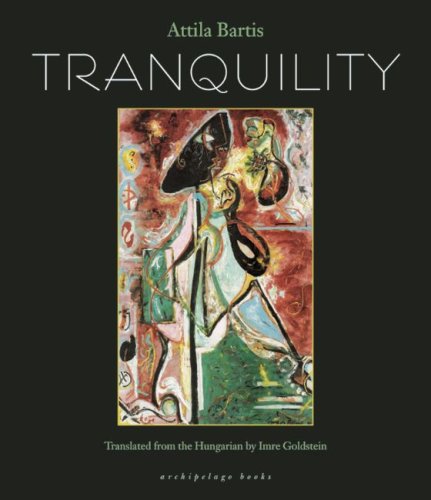
Attila Bartis: Tranquility

This book just won the Three Percent Best Translation of 2008 prize, and while I can’t speak to the translation (though I have it on good authority that it’s excellent–thanks GJ), I was happy to have it win, being a booster of Hungarian lit in general (and Laszlo Krasznahorkai in particular). Jeff Waxman describes a not-uncommon worldview of Hungarian literature when he says, “Tranquility is a book of unfathomable realism—by which, of course, I mean endless cruelty, depthless pain and emotional deadness.” Hungarian director Bela Tarr said it even better:

And back then I thought “Okay, we have some social problems in this political system – maybe we’ll just deal with the social question.” And afterwards when we made a second movie and a third we knew better that there are not only social problems. We have some ontological problems and now I think a whole pile of shit is coming from the cosmos. And there’s the reason. You know how we open out step by step, film by film. It’s very difficult to speak about the metaphysical and that. No. It’s just always listening to life. And we are thinking about what is happening around us…I just think about the quality of human life and when I say ‘shit’ I think I’m very close to it.

And it’s fair to say Bartis subscribes to something on the order of this view. What he brings to Tranquility that is very much his own is hysteria, at a level that is rarely encountered at such sustained length. Bernhard is a good contrast: while Bernhard’s narrators are obsessive, ranting, and irate, they are very rarely hysterical. Bartis’s breathless portrayal of unrelenting stress and compression owes the most, I’d say, to Celine and his spiritual disciple E.M Cioran, with a bit of Portnoy’s Complaint (namely, the end) mixed in.

And with a book that is pitched so consistently at the level of hysteria, Bartis has to keep the changes coming so that the tone does not become monotonous. The story of Andor, a middle-aged man, and his exceedingly unhealthy realationship with his mother and only slightly healthier relationships with several women careens around just as Andor careens between the three women in his life (and the one absent one, his sister), never settling in one place long enough to set up a sustained narrative. This is evidently intentional, as the plot necessarily cannot get started with such a tone at work. Any concession to traditional narrative dynamics would wreck the effect, and this book is all about effect.

Such a sustained howl can become numbing or exhausting; at times Bartis piles on so much pain that the book risks becoming a shaggy-dog story. It’s ultimately Andor’s relationship with his mother, and the sheer acuity and inexorability of it, that holds it all together. The other women are sweet relief in comparison. For Bartis, it seems that that level of hysteria, that sheer limit at which there is no appeal to reason and no possible escape, is fundamentally fostered in the mother-son bond.

More Notes on Roberto Bolano’s 2666

(See part one.)

Even as the second part (about Amalfitano, a peripheral character in the first section) begins, Bolano is already undermining the first section. In the story of pharmacist/teacher/literary enthusiast Amalfitano, citizen of Santa Teresa and general sad sack, Bolano gives a richer, more detailed portrait of life than anything on hand in the first section, and the specters of the four characters and their bedroom athletics quickly disappear in favor of the muddy and depressing history of Amalfitano. His wife, as it turned out, ran away from him and their daughter years ago to pursue a silly Bohemian existence of the sort that the first section bloodlessly presented, and Bolano presents it as being about as meaningful. (When she returns years later, she observes that Amalfitano has changed, and Amalfitano observes that she has not. She mistakenly takes it as a compliment.)

When Amalfitano begins to go a bit insane, the literary knowledge in his head jumbles itself incoherently, attempting to find a meaningful form and failing. He reads a book about a bizarre paranormal conspiracy theory. He dreams.

Failure and inadequacy replace the indulgence of earlier, but Bolano, with full certitude, tries to elevate the material to the level of truth. There’s a hard-boiled attitude to Bolano’s repeated myth-busting and proclaiming of the failures of the literary project and its world. The problem with such an attitude is that its effectiveness lies in the vividness of the portrayal, not with the attitude itself, or else people would be reading E.M. Cioran rather than Dashiell Hammett. And Amalfitano himself, unglamorous and earnest, is what makes it vivid. When the fourth section (about the murders) rolls around and Bolano abandons most of the embellishments for a flat recounting of the facts, he is at his best.

What remains from the first section are not the scholars (who, in a rather obvious move by Bolano, ridiculed Amalfitano for being a literary neophyte), but the small affair that one of the scholars had with a local girl, Rebeca, whom he used and tossed away while nursing his own romantic wound. Now Rebeca is part of the real world and he is not, and her life and the danger she is in, with girls like her being murdered constantly, remain in the air long after the scholars have been forgotten.

A Bit on Kant’s Schematism

It should be noted how Kant’s proposal for connecting the
sensible and the conceptual, though superficially straightforward, is at another level extremely
perplexing. Is a transcendental schema a thought about time, or is it time as thought in a certain
way? Our ways of referring to transcendental schemata inevitably assimilate them, it would
seem, to one side or the other of the concept/intuition divide. Moreover, it appears necessary to
do exactly this, if we are to answer the question of what they are, or say anything contentful
about them. The cost of the assimilation, however, in either direction, is to make them
apparently unfit for their designated mediating role: if they are either concepts with a special
relation to intuition, or intuitions as formed conceptually, then they seem to presuppose the very
possibility of connecting the sensible and the conceptual which transcendental schematism is
invoked to explain.

Kant may declare that transcendental schemata are irreducibly sensible-and-intellectual, and
that this is how the question of their identity should be answered. If so, Kant’s original division of
our representations into intuitions and concepts is not exhaustive, for there is a third class,
about which we can say very little, other than that it is dependent on and somehow derivative
from the others. We can specify it in terms of the transcendental role to which the problem of
relating concepts and intuitions gives rise, but the manner of its derivation, and the nature of
schemata, we cannot specify. Note, it is not just that we can say relatively less about schemata
than we can about intuitions and concepts, and that we cannot identify their ultimate source; we
are equally ignorant of the grounds of our faculties of sensibility and understanding.
Transcendental schemata remain in a special sense hard to grasp, because they are required to
combine in themselves two kinds of property, or representational functions, the seeming
immiscibility of which is precisely what made us introduce them in the first place. That this is
nevertheless Kant’s own view of the matter is, plausibly, what is suggested by his statement that
schematism is ‘an art concealed in the depths of the human soul, whose real modes of activity
nature is hardly likely ever to allow us to discover’ (A141/B180-1).

Sebastian Gardner

I’ve been accused of obsession with the schematism, but the intuition-concept gap is for me the core problem that Kant runs into, and I have never been able to find an adequate solution in Kant for it. Here’s Paul Guyer’s unsatisfactory explanation:

Thus, in the case of
the categories our concepts are not “homogeneous” with our objects, and
some intermediary has to be found in order to make them so.
But this is
not the case with our other concepts, which are inherently homo-
geneous with their objects. A pure mathematical concept like circle is
homogeneous with our experience, because it describes its object in terms
of properties that can be directly presented in experience – that something
is a curved, closed line every point of which is equidistant from its center
is the kind of thing we can observe because the pure form of all our outer
intuition is spatial. And an empirical concept like plate or dog is already
homogeneous with its object because it includes predicates that correspond immediately to observable properties of objects, whether those
properties are pure, like the circularity of a plate, or empirical, like its non-
porousness or like the furriness or noisiness of a typical dog.

If you’re willing to accept that Platonic concepts like “plate” and “dog” have exact referents in the real world, then fine. But Kant doesn’t (since he thinks the application of all concepts is normative and prescriptive and subjective) and his whole project is to figure out a way to salvage conceptual mental content out of a non-conceptual world.

Anyway, I mention this because I was just thinking about how much of modern philosophy grows out of exactly this particular problem. Kant wasn’t the first to come up with it, but I think it’s his formulation of it and failed solution to it that echoes in Russell (who tries to pull the same trick solution), Heidegger (who tries to punt the problem away), and many others.

And ultimately there’s something a little pleasing in Kant’s ceding of this problem to “art,” which is a rare concession on his part.

« Older posts Newer posts »

© 2026 Waggish

Theme by Anders NorenUp ↑