Waggish

David Auerbach on literature, tech, film, etc.

Category: Essays (page 33 of 46)

Gene Wolfe Redux

I have never gotten as much flak for an entry as I have for my criticism of The Book of the New Sun, and since people have been reading that troublesome entry lately, I thought I’d add that I do like Wolfe, or at least find him very intriguing. I see him as having a large wellspring of talent that, for a number of reasons, goes off track too frequently to write much that is genuinely successful, even if it is highly evocative and complex. When he avoids the pitfalls, as with “The Death of Doctor Island,” he can be well-nigh brilliant.

So among the world-building riches that his work offers, I think the problem arises in his combination (and misalignment) of narrative (epistemic) subjectivity and factual absolutism. He puts readers through knots trying to figure out what goes on in his novels and stories, but both in the work and in Wolfe’s own interviews, there is no doubt offered that all questions have answers: you just need to figure them out. If you enjoy the puzzles, great, but there is still something unsatisfying to me in knowing that any given question pretty much does have a simple yes/no answer (or, and this is a significant exception, chalked up to divinity as per Wolfe’s Catholicism), and that much of the obscurity is not serving any other purpose other than as “entertainment” for the reader. Take this excerpt from a Q&A between some devoted fans and Wolfe:

5. Do you care to enlighten us as to whether the Enlightenments are purely miraculous or are concurrent with activities of Mainframe or Pas? — They are purely miraculous.

10. What are the dimensions of the Whorl? — I don’t know.

12. Who was Blood’s father? — Patera Pike. [DRL: This was a complete surprise all round, by the way.]

15. Is the Outsider a form of Severian? — No. Severian is a form of the Outsider.

21b. Who is the narrator of the very last chapter …? — I think you mean the Afterward. It was written by Hoof, Hide, and their wives — but mostly by Hide.

Is the Outsider a spiritual God? Or another virtual being? — The Outsider is a spiritual God.

To continue on the issue of divinity in Wolfe’s work, I wanted to point Wolfe readers to Five Steps Towards Briah, an essay by Nick Gevers that is the single best thing I’ve read about Wolfe. Gevers gives a remarkably coherent and comprehensive account of Wolfe’s agenda, interests, themes, and techniques, and more significantly, how they reinforce one another. His analysis is of The Book of the Long Sun, but his points apply more or less to all the Wolfe I have read. Gevers’ key point, with which I agree:

The entire 1400 page text [of The Book of the Long Sun, with its hundreds of characters, scores of voices, and countless veering twists of plot, is an exhaustive proof by Wolfe of the need to obey a simple injunction: transcend the material world. As a very subtle but also very emphatic Roman Catholic propagandist, Wolfe is commanding us to perceive our bodies and our physical surroundings for the pale mortal envelopes that they are, and rise into the divine light. Any godless secular world, he declares, is Hell, a place where any solutions are temporary, partial, empty. The Whorl is a reflection of contemporary Earth, that fallen spiritual wasteland. The way out is not fruitless secular endeavour, but rather an ascent back towards God, an exodus into His Creation.

The ultra-short summary: Wolfe’s tales are Christian parables (or propaganda, if you will) told or retold by acolytes of one form or another with imperfect knowledge, just as the Gospels are.

Wolfe is not quite as explicit about his religious content as James Blish was in his singular novel A Case of Concience (which overtly treats the Manicheistic heresy), but ultimately there is less doubt about Christian doctrine than there is in Blish, and more emphasis on the One True Way, getting past all the false gods to reach the true one. Gevers maintains, and I agree, that beneath all the puzzles and complexities, this is the fundamental purpose and position of Wolfe’s work. Determining the worth of such a message–that anything that can be known in this world will fall short in providing purpose in life and one must look to the transcendent and undescribable–is up to the individual reader.

Oh, and also…

The Gene Wolfe challenge: in response to some of the comments made on my last entry that insisted that all narrative ambiguity in Wolfe was easily soluble by close reading (my thanks to Jonathan Rock for instead answering my questions about the ambiguities), I issue the following challenge: give a coherent and defensible account of the actual events of Wolfe’s “Seven American Nights,” an eerie postcolonial story that, as far as I can tell, collapses into obscurity and narrative indecipherability by its end. I cannot find a commonly accepted account of the plot, but here’s an excerpt of Robert Borski on the Wolfe mailing list trying to figure things out, just to let everyone know what they’re in for:

When the narrative recommences it’s with the passage I quote at the beginning of paragraph 9, wherein Nadan wants us to believe that someone has broken into his room, relocated his journal, and eaten the missing egg. Actually, however, I believe this is being written an entire day later, on the night that concludes Day 6. Nadan makes it seem as if the break-in and the events preceding it are still part of Day 5, but I believe Wolfe provides us with several clues that it isn’t when he has Nadan reprise the evening’s activities. As we expect, Nadan goes to the theater; when he arrives, however, much to his surprise, he discovers that Bobby O’Keene is already there and preparing to go on-stage. “You are free,” Nadan says. But given Nadan’s and Ardis’s previous frustrations with the police (who, remember, seem to believe there’s something more to the alleged robbery than a simple mistaking of intentions), in addition to the sorry state of the prisoners, is it likely that O’ Keene is going to be this well groomed and composed–especially since Nadan describes him as having been beaten to the ground by the crowd that’s witnessed the robbery–and ready to trod the boards?

Ardis, in turn, then asks Bobby, “Was it very bad?” To which the actor responds, “It was frightening, that’s all. I thought I’d never get out.” But if he was arrested late the night before, and released the following day, perhaps being confined, at the most, 16 hours, this hardly seems to warrant a comment about never getting out. In addition, when Bobby says, “I hear you missed me last night,” Ardis responds, “God, yes.” But if Bobby has actually been confined in jail for a day-and-a-half, Ardis may well be commenting on the poor performance of his stand-in (the fact that Bobby has been missed by her is obviously communicated by someone else).

I gave up. But you, Gene Wolfe fan, should not!
Jean Eustache: Mes petites amoureuses

Childhood, says the Children’s Encyclopaedia, is a time of innocent joy, to be spent in the meadows amid buttercups and bunny-rabbits or at the hearthside absorbed in a storybook. It is a vision of childhood utterly alien to him. Nothing he experiences in Worcester, at home or at school, leads him to think that childhood is anything but a time of gritting the teeth and enduring.

J.M. Coetzee, Boyhood

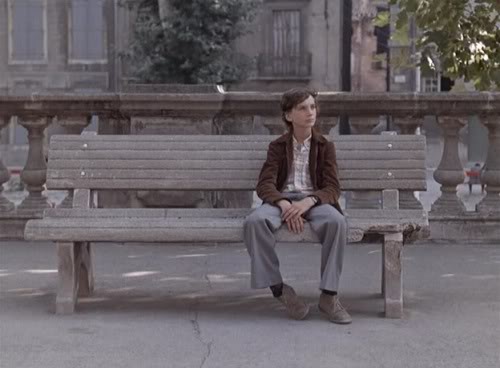
There have been many movies portraying various childhood hells with different degrees of sentimentality and relief, but I can’t think of one that competes with Jean Eustache’s Mes petites amoureuses in portraying childhood as so sheerly joyless, so gray and unappealing. The world is not as brutal to Daniel, its young teen protagonist, as it is to anyone in a Dardenne film or Francois in Maurice Pialat’s L’Enfance Nue, nor is Daniel a delinquent on the order of Francois. But nor does Daniel experience much of the momentary fun that those characters get. So the movie is of a piece with Eustache’s earlier work, The Mother and the Whore, in its portrayal of the denial of pleasure in what for most people might be called the pursuit of happiness. Not torment, just jadedness.

Daniel leaves the countryside to move in with his mother and her rather lame lover. They treat him with indifference and contempt, though not quite outright abuse. He hangs out with locals, eventually learns how to pick up girls, gets a lousy job at a bike shop where he watches his employer rip off the customers. He provides suitably numbed voiceovers to some of his experiences, flatly detailing his feelings (“I was scared”). In contrast to Jean-Pierre Leaud’s charisma in The Mother and the Whore, the actor playing Daniel is reticent and a bit stiff; you can’t really get close to him, not that anyone in the movie ever tries. His most animated moments are when he is learning to pretend, as when simulating a circus sword-swallower’s act by lying on (carefully placed) broken glass, or when he is feeling up a girl in the movie theater by dutifully imitating a boy a few rows down.

There is one exceptional moment, and I don’t know whether to call it a slip on Eustache’s part or the final nail in the coffin of Daniel’s dreams. Daniel speaks to the only student he knows, in one single close-up, in his only extended monologue in the whole movie:

DANIEL: I read a book about this guy’s high school years. He said his French professor really made him sick when he lectured about passion in the works of Racine and Corneille. He said the same things year after year. Finally the words had no sense, no heart. That professor had no business talking about passion. He knew the plays inside-out, but he’d never lived them. Whereas the student felt he would live those passions later on…. Any opinion?

STUDENT: That you run off at the mouth. Coming to the cafe?

And that’s that. He goes off with some boys to make out with girls and gives up on school. When a girl says she can’t sleep with a boy until they get married, he thinks, “It seemed to me I’d heard it all, that I knew the whole thing by heart.” Eustache committed suicide seven years after this film.

Dennis Potter: Blue Remembered Hills

I was thinking about this old tv play (available entirely on youtube, hooray) in connection with two other old French films about childhood that I recently saw, Naked Childhood and My Little Loves. As much as they do their best to deromanticize childhood, this one may have them beat, and not just because adults are playing the children. The French movies all have alienation in one way or another, but there’s not a lot of that here: these are younger kids before the age of introspection. And what a terrible age it is. In the absence of the cuteness of little kids (the actors are mostly rough-looking except for Helen Mirren, who looks somewhat gangly but mostly looks like Helen Mirren), what shows through?

First there is fear. The boys are adventure-mag and war-informed, but they have yet to grasp the size of the world and so they are quite scared that the war is very close to them and very real. When they aren’t playing little war games among themselves, they are quite terrified that they are all going to die at German hands, even in a remote forest in England. Many of their fathers are away and some are missing, and the children switch back between having no sense of the reality of it and being frightened by the Germans as bogeymen, the sort of monsters you’re repeatedly told aren’t real, except these are. That wrenching movement between the serious and the frivolous is what stays, and lord knows it’s a good thing that kids have it, because the bare fear looks horrific.

They do have one other positive mechanism, which is camaraderie. The boys and girls fight with each other, but when there is a threat, even an imagined one, the kids are suddenly all in it together, and they know that they are the protagonists and the evil Germans are the bad guys, so at least they’re all on the same side. This even extends, to a point, to the miserable outcast of the group, the boy called Donald Duck who is mercilessly teased and demeaned. When the war games are over, the rest of the kids indulge in some rampant cruelty–the third main motif–against Donald that ends up going very badly for him, and too late, the others realize that they crossed the line and they feel bad. Though they mostly make excuses for themselves, they do acknowledge a certain undebatable humanity on his part. It’s small consolation for Donald, but it does draw a certain line.

Poor Donald, though, since up until that point he has been an outcast and the only one really excluded from any compassion from the others. He blubbers and he is really, truly frightened, and so he is deprived of the any of the consolation of camaraderie, and he gets stuck in the fear. It’s not just loneliness, though the lack of support he feels from anyone else is palpably agonizing, but it’s also that by lacking that communal outlet to play together and have adventures, he is locked in one of the most miserable places that a person can be, before a child learns that they aren’t always going to be so completely helpless and alone. It’s wretched to watch.

Isak Dinesen: The Dreamers

Dinesen was Danish, moved to Africa for a spell, and, under a pseudonym, wrote fiction in English that evokes German Romanticism more than any English precedent. Dinesen admitted the willfully anachronistic quality of her writing, and yet it is still surprising just how greatly her work involves characters who are pretending to an ideal, and how they strive after a Romantic ideal analogously to how Dinesen pursues the Romantic and gothic qualities in writing.

The two greatest stories in Seven Gothic Tales are the two longest: The Deluge at Norderney and The Dreamers. Both involve people telling tales of themselves and others in nested layers, a la Jan Potocki’s The Manuscript Found in Saragossa. Both feature characters who, through an act of pretending, become greater than they otherwise would be, though this pretending ultimately kills them as well. Both subordinate the idea of a healthy and loving relationship to one containing moments of absolute intensity.

The Dreamers is the more interesting, though, because of the self-consciousness of the characters and of the author in writing it. It is about a beloved opera singer, Pellegrina, capable of transfixing audiences and earning their devotion and adulation, which she relishes. After a fire in the theater, she loses her voice, and, devastated by the loss of her ability to compel attention from others, she vows:

I will not be one person again, Marcus, I will be always many persons from now. Never again will I have my heart and my whole life bound up with one woman, to suffer so much. It is terrible to me to think of it even. That, you see, I have done long enough. I cannot be asked to do it any more. It is all over.

And so, it is revealed at this point, it turns out that Pellegrina is all three of the women in the earlier tales told by the three men in the story, each of whom was enraptured by a woman who then disappeared at the moment of their greatest passion. The stories are quite diverse, the positions of the women completely different, but the course of the love affairs is the same.

In the absence of her ability to compel people wholly through art, Pellegrina chooses to do so by acting. The situations that each of the men describe are intense, melodramatic, and even contrived. Pellegrina has orchestrated these scenarios so that she can bring about passions at the level of those of her past audiences. But the difficulties of life mean that she works on one man at a time, and because she is acting, the situation is always asymmetric. He feels love; she feels the devotion that she previously felt onstage. And because it is a pretense on her part, she must flee the scene before too long, or else the entire purpose of the pretense would disappear as reality bled through.

So there is a peculiar relationship portrayed between art and life here. The ultimate mode of passion is not between lovers, but between spectator and performer. The Romantic ideal of intensity is possible only in a contrived setting, be it explicitly artistic or merely socially engineered. This ideal doesn’t just emerge out of the pretense of Pellegrina; it requires it. Being an actual person, an ordinary human being, negates the intensity of the Romantic experience. And such intensity is only possible for a limited time while there is a performance. It is these moments that provide satisfaction of the ideal, while returning to ordinary life is disappointing but for the memories of those moments.

I think that this fits exactly with why Dinesen wrote in tribute to and in imitation of forms that were long past: it is her form of pretending, without any prejudice associated with the word. In life, as with Pellegrina’s men, it’s necessary not to know that there is a pretense, but in art the spectator can experience transcendence with full knowledge of the pretense of the artist.

Montaigne: Apology for Raymond Sebond

For a reputedly humanistic and temperate philosophy, the Apology [sic] for Raymond Sebond comes off as one of the most intemperate of Montaigne’s essays. He works himself into a frenzy of attack against all claims and pretenses of human reason, proclaiming their impotence against the works of God and fate. He quotes the Roman astrologer Manilius in tandem with Lucretius to emphasize the hopeless fatalism that is driving him. His contempt from constructive philosophy from Plato to Aristotle to his time builds, until he is even attacking the Pyrrhonists for the hubris of their claim to not knowing anything:

Ignorance that knows itself, that judges itself and condemns itself, is not complete ignorance: to be that, it must be ignorant of itself. So the profession of the Pyrrhonians is to waver, doubt, and inquire, to be sure of nothing, to answer for nothing. Of the three functions of the soul, the imaginative, the appetitive, and the consenting, they accept the first two; the last they suspend and keep it ambiguous, without inclination or approbation, however slight, in one direction or the other.

The Pyrrhonians have kept themselves a wonderful advantage in combat, having rid themselves of the need to cover up. It does not matter to them that they are struck, provided they strike; and they do their work with everything. If they win, your proposition is lame; if you win, theirs is. If they lose, they confirm ignorance; if you lose, you confirm it. If they prove that nothing is known, well and good; if they do not know how to prove it, just as good. So that, since equal reasons are found on both sides of the same subject, it may be the easier to suspend judgment on each side [Cicero].

Pyrrho did not want to make himself a stump or a stone; he wanted to make himself a living, thinking, reasoning man, enjoying all natural pleasures and comforts, employing and using all his bodily and spiritual faculties in regular and upright fashion. The fantastic, imaginary, false privileges that man has arrogated to himself, of regimenting, arranging, and fixing truth, he honestly renounced and gave up.

(tr. Frame)

Perhaps Montaigne here is susceptible to Hans Blumenberg’s attack on stoics and Epicureans: of abandoning one’s ambitions and will in favor of what minimal pleasure may be grasped from the life at hand. But Montaigne is never consistent nor focused in his views, and the frustration that drives this essay appears as directed at the stoics as at anyone else. As much as it derides the Christian apologists for saying that God will take care of it all, the Pyrrhonists fall under attack for making their practice into a dogma as well. And so at the end, as Blumenberg might have predicted, Montaigne falls into something of an otherworldly Gnosticism, denying our knowledge of God and insisting that faith alone may allow us to escape this awful and uncontrollable world. Hence, again, why he finds so much use in Manilius’s fatalistic astrological texts: to conclusively say that we are not in control of our lives.

The fatalism is the more disappointing aspect of the essay, which elsewhere delves into enough cosmology to make it Montaigne’s Timaeus. I don’t see much orthodox skepticism in it, even if Montaigne was dwelling on the subject. There is too much reference to convenient beliefs, the need for happiness, pleasure, and suffering for Montaigne to attach himself to classical skepticism alone. Nor does he particularly play one belief off against another; each one comes in for attack individually using assaultive common-sense “evidence,” much as Schopenhauer would do centuries later in trying to convince people that the world was truly unbearable.

Instead, I find the constructive aspect of the essay to be the super-Pyrrhonic method that Montaigne employs, jumping around from topic to topic and never finding any satisfaction. Although this method draws Montaigne to assorted conclusions as to humanity’s powerlessness, uselessness, and unhappiness, these are all fallacies on his part, stemming from his self-professed lassitude as a thinker. It is the dissatisfaction that emerges as the constructive attitude, not the purported skepticism or fatalism. It is an emotional and personal method.

« Older posts Newer posts »

© 2026 Waggish

Theme by Anders NorenUp ↑