I’m proud to announce that today, Pantheon Books is publishing BITWISE: A LIFE IN CODE. The New York Times Book Review kindly says, ““[Auerbach] writes well about databases and servers, but what’s really distinctive about this book is his ability to dissect Joyce and Wittgenstein as easily as C++ code.” I’m grateful that the book has been so well-received.
I did a Knopf Q&A around what inspired me to write it, as well as my thoughts on technology more generally.
Trump brings out the worst not just in his supporters, but also in his opponents.
For years, I watched as the rhetoric of talk radio and Fox News was assimilated into the Republican party. It homogenized Republican discourse and kept up a level of anxiety over everything from terrorism to healthcare to Barack Obama himself. The left (and that elite part of the center that now considers itself part of the “resistance”) had its own sub-discourses, but aside from Obama’s fleeting inspirational moment in 2008, there was no common thread that kept Democrats, liberals, and leftists attuned to a single issue. Not even the Iraq War was sufficient. For a genuine mass left movement, you have to look back to Vietnam.
That has changed with Trump. Opposition to Trump personally has become the unifying thread. Standard Republican policies are far more terrifying under the auspices of Trump than they otherwise would be.
Midterm elections historically result in the opposition party gaining ground as voters grow disaffected with the President. No one knows whether that will hold true this year. This is partly because of the unprecedented (in modern times) degree of polarization in the electorate, and partly because of Trump himself.
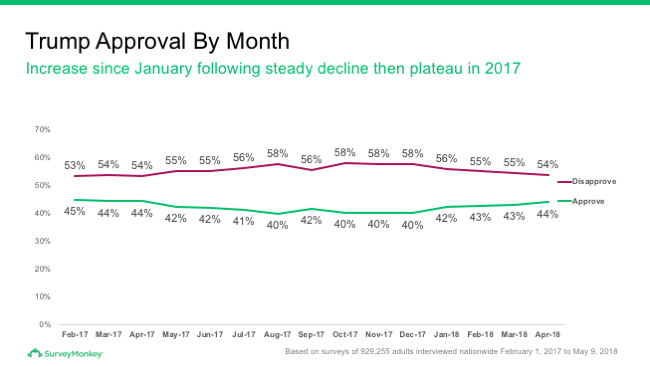
It’s still worth remembering Trump’s fundamental continuity with Republican politics, if not with its leadership. Trump’s raw, resentment-driven brand of nativist politics beautifully massaged the existing Republican base that developed out of the Southern Strategy, talk radio, and the Tea Party. But his appeal is evidently so much more visceral than most any other recent politician that his approval (and disapproval) ratings have been far more consistent than George W. Bush’s were.
While the world went mad this year, I retreated a bit and did more reading than I had in some time. I have seen the pendulum of public sentiment cycle from complacency to hysteria and back twice now, and I am more fatalistic than ever about such cycles having to take their course. (My description of Thomas Pynchon’s “decoherence events” applies just as well to the Trump presidency as it does to September 11, 2001.) Being part of the collective public discourse this year was unhealthier than in any time I have ever seen.
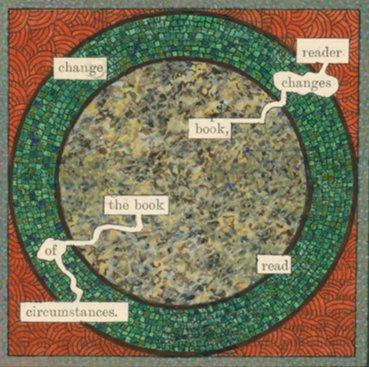
I believe all the titles below deserve attention. The top books have been chosen based on personal significance and relevance. Appiah’s As If is a plea for a cosmopolitan pluralism (of provisional viewpoints, not of truths) based on a reading of the great Hans Vaihinger. It is a theoretical work that has far more relevance to technology than it first appears, as I try to explain in my forthcoming Bitwise: A Life in Code. Földényi’s Melancholy is a Burton-inspired chronicle that bests a thousand other intellectual histories of its kind. It spoke to me of what it is to be the sort of person who feels the need and drive to read all these books in the first place, and of the intangible benefits I gain from them. And the purportedly final version of Tom Phillips’ A Humument is a thing of beauty, drastically different from its previous editions in many regards, and one of the deepest texts of our time, fifty years after its first publication.
The greatest novel I read this year was Thomas Pynchon’s Mason & Dixon, the right novel for the right moment, but not one published in 2017.
In an attempt to provide a bit more apparent order, I have created a few subcategories for nonfiction. These are quite approximate; some books could have easily gone under a different heading. They are there to break the lists down into more manageable chunks.
When it comes to books, my eyes are bigger than my…eyes. Books under “Of Interest” are there either because (1) they are too out of my areas of knowledge for me to feel comfortable recommending them, (2) I have sufficient reservations about their content but feel they are too significant to ignore, or (3) I just haven’t read enough of them. I would feel terrible not noting Slezkine’s The House of Government, but I did not have time to read most of its 1100 pages.
The Hack: votes to cut health insurance for millions in order to please donors, party elders, and constituents.
The True Believer: votes to cut health insurance for millions on the belief that deregulation and the free market will lower prices so that all will be insured for even less.
The Paranoid Patriot: votes to cut health insurance for millions to stop America from turning into a socialist dystopia.
The Character Builder: votes to cut health insurance for millions because entitlements encourage laziness and unemployment.
The Pruning Hook: votes to cut health insurance for millions because the uninsured are a drag on America and should be discouraged from reproducing or living.
I don’t have an answer, but on a gut level I fear the Hack the least. The Hack does not terrify me because a self-interested politician with flexible principles stands the greatest chance of bending to public and private pressures and making compromises. A politician who acts out of iron dogma, paranoid fear, or moral puritanism is likely to stick to their guns well past the point of self-interest.
(There is room for a sixth sort of politician, the Rational Guardian, who considers the evidence and votes out of well-considered, disinterested rationales, but such creatures do not exist.)
Much of the GOP’s stress over the last year stem from its representatives being strewn across all five types. Even in the absence of Trump, the varying motivations would have caused trouble for any attempted repeal of the Affordable Care Act, even as political pressure from various sides demands that a repeal be passed. The same sort of stress is plaguing the tax bill currently, but the looser political requirements around such a bill (“cut lots of taxes” vs. “repeal a specific bill”) make passage in some form far more likely.
So while the off-year elections constituted a vague repudiation of Trump, they haven’t changed the calculus for the Republicans terribly much. The Democrats won governorships that they absolutely needed to win, which was more cause for existential relief than celebration, and they made huge gains in the Virginia legislature, though the ramifications of those gains are uncertain, as Virginia has been turning decisively “blue” for some time thanks to suburban DC spillover. The real story resides in Pennsylvania, Michigan, Florida, Ohio, and Wisconsin, and it has yet to be told.
The Republicans, in turn, have set about trying to accomplish exactly what they would have tried to accomplish had any non-Trump Republican been elected. Assuming that Trump doesn’t start a war or blow up the world, the party’s projects will have far more lasting political impact than Trump will. (Trump’s lasting impact will likely be psychological and agonistic—traumatically so.)
The two most important projects, which are attracting far less attention than Trump’s most comically useless moves, are the tax bill and the Federalist Society’s plan to pack the federal courts with conservative apparatchiks. If Republicans can get even part of the court-packing scheme through, they will be in a position to rout non-Republican/non-Federalist governance on a far greater level than has been seen to date. And judges, more than any other sort of politician, tend not to be Hacks. A great many Federalist Society sorts are indeed True Believers.
But at the moment, the tax bill looms far larger, as potentially the most consequential piece of legislation since the Affordable Care Act, which it easily dwarfs in impact. And there, it’s the Pruning Hooks that may win the day. They may be smaller in number, but they are attuned more closely to real trends rather than imaginary dogma. The tax bill marries all five types of representatives, but its ultimate effects will, I suspect, be those that the Pruning Hooks wish for.
II.
Our world functions on commerce. Many call it “capitalist,” either to praise it or deride it, but the term is so wide that it says little about how the global economic system actually sustains itself. The word “neoliberal,” aside from suffering from chronic misuse, is too narrow, as there is much about our current world system that Keynes or Hirschman would support. So I will just call it the global economy.
There are two requirements for the global economy to continue to function, broadly speaking, as it has since the Industrial Revolution.
There must be modest growth, on average, in the medium term.
The average net contribution of a human life to a national economy must be non-negligible.
If the concept of investment is based around robbing future Peter to pay present-day Peter, there’s little trouble around the temporal redistribution of funds as long as future Peter is far richer. That is, as long as growth continues. (“Capitalism: it’s temporal socialism!”) When you start having second- and third-order financial products around such expectations, there’s still no problem as long as everyone continues to believe that future Peter is wealthy beyond belief.
If our collective faith in future Peter falls, our present economy declines. This is, in part, what makes nativist movements dangerous: they appeal not to any sort of economic progress but to resentment and zero-sum games. They accelerate contradictions, in other words.
Economic hawks take a more atomistic view to these issues. They look not just at countries, but at individuals. Rather than seeing economic progress as a gradually rising tide, they see a contest between those individuals who raise the tide and those who drag it down. The apportionment of these responsibilities is something of a subjective measure, since it’s as much a function of money you have as work you do, and you are judged not on the proportion of your money you spend but on sheer total. Regardless, the hawks fixate on those whose GDP contribution is negligible, which would be the poor.
There have been two infamous formulations of hawkish dogma. One was Mitt Romney’s “47 percent” comment in 2012, referring to the number of Americans who pay no federal income tax (though many are still subject to payroll and state taxes), and are thus seen as being a drag on the progress of the nation. It still baffles me how anyone could have though that Donald Trump possessed an iota more compassion for that 47 percent (much less compassion for anyone who is not him), but a sucker is born every minute.
The most recent data from the IRS, in 2000, show that the top 5% coughed up more than half of total tax revenue. Specifically, we are talking about folks with adjusted gross incomes of $128,336 and higher being responsible for 56% of the tax take. Eyebrows raised? There’s more. The top 50% of taxpayers accounted for almost all income tax revenue — 96% of the total take.
Almost 13% of all workers have no tax liability and so are indifferent to income tax rates. And that doesn’t include another 16.5 million who have some income but don’t file at all.
Who are these lucky duckies? They are the beneficiaries of tax policies that have expanded the personal exemption and standard deduction and targeted certain voter groups by introducing a welter of tax credits for things like child care and education.
This complicated system of progressivity and targeted rewards is creating a nation of two different tax-paying classes: those who pay a lot and those who pay very little. And as fewer and fewer people are responsible for paying more and more of all taxes, the constituency for tax cutting, much less for tax reform, is eroding. Workers who pay little or no taxes can hardly be expected to care about tax relief for everybody else. They are also that much more detached from recognizing the costs of government.
All of which suggests that the last thing the White House should do now is come up with more exemptions, deductions and credits that will shrink the tax-paying population even further.
To me, the explanation for the shifting tax burden is that the rich got a lot richer and inequality has skyrocketed, not that the income tax system unfairly privileges the poor. If you own 50 percent of the country, you probably should pay 50 percent of the tax. Romney and the WSJ ignore those arguments, instead fixating on how people should have “skin in the game.” They argue, with perfect cynicism, that if the Republicans raise taxes on the poor, the poor will be more likely to vote Republican.
The Republicans may be about to put that to the test. The GOP tax bill looks to be “Requiem for the Lucky Ducky,” fixating on a huge corporate tax cut at the expense of deductions, exemptions, health insurance subsidies, and quite a bit else. If it passes, the Republicans may not need total control of Congress or the presidency after 2018, since the bill will be terribly difficult to undo.
But why? I think it is ultimately the Pruning Hook.
III.
The National Review‘s Kevin Williamson was brutally honest last year when he excoriated poor white working class communities. (Excoriating poor non-white communities is mostly superfluous in such circles.) For all the GOP’s supposed evangelism of white working-class values (and Trump’s pandering to them), the GOP’s ongoing relationship to them is better captured by the Never-Trumper Williamson in Chaos in the Family, Chaos in the State: The White Working Class’s Dysfunction, taking Garbutt, New York as his whipping boy:
The Washington Post’s “Wonkbook” newsletter compared the counties Trump won in the so-called Super Tuesday primaries with the demographic data and found trends that will surprise no one who has been paying attention (and certainly no one, I hope, who has been reading this magazine). The life expectancies among non-college-educated white Americans have been plummeting in an almost unprecedented fashion, a trend not seen on such a large scale since the collapse of the Soviet Union and the social anarchy that prevailed in Russia afterward. Trump counties had proportionally fewer people with college degrees. Trump counties had fewer people working. And the white people in Trump counties were likely to die younger. The causes of death were “increased rates of disease and ill health, increased drug overdose and abuse, and suicide,” the Post’s Wonkblog website reported.
The white middle class [sic] may like the idea of Trump as a giant pulsing humanoid middle finger held up in the face of the Cathedral, they may sing hymns to Trump the destroyer and whisper darkly about “globalists” and — odious, stupid term — “the Establishment,” but nobody did this to them. They failed themselves.
Nothing happened to them. There wasn’t some awful disaster. There wasn’t a war or a famine or a plague or a foreign occupation. Even the economic changes of the past few decades do very little to explain the dysfunction and negligence — and the incomprehensible malice — of poor white America.
The truth about these dysfunctional, downscale communities is that they deserve to die. Economically, they are negative assets. Morally, they are indefensible…The white American underclass is in thrall to a vicious, selfish culture whose main products are misery and used heroin needles. Donald Trump’s speeches make them feel good. So does OxyContin. What they need isn’t analgesics, literal or political. They need real opportunity, which means that they need real change, which means that they need U-Haul.
If you want to live, get out of Garbutt.
I think this deserves to stand alongside the Lucky Ducky editorial as a statement of purpose among Republican elites (e.g., Paul Ryan, Mitch McConnell, House Republican leadership, the majority of Republican senators, the Federalist Society, the Kochs). The two messages Williamson delivers to Trump’s base are, “You contribute nothing,” and “You’re going to die.” In other words, they are a drag on America. They’ve had their chance, and they blew it. (Williamson does not really expect them to move.) Social Darwinism must take its course, just as it should take its course on the urban poor. Prune the tree of prosperity.
IV.
Ironically, the left increasingly agrees. When it comes to poor white Trump-voting areas, the right wants these communities to die out because they’re economically worthless and unproductive. The left wants them to die out because they’re racist, sexist, and morally backwards.
For both Republican and Democratic elites, a vote for Trump has come to be seen as a civic disqualifier. Two political contentions—(1) Trump voters were motivated not by economics but by racism; and (2) there is no such thing as a “good” Trump voter—have become articles of faith among the intelligentsia on both sides.
These contentions echo Williamson’s argument: nothing happened to them. What’s unusual, however, is that the left rejects superstructural Marxist arguments that view individual beliefs as a consequence of macrohistorical currents (racial, economic, or otherwise). Rather, both right and left have embraced a Protestant individualism, seeing the 2016 election as a test of one’s soul.
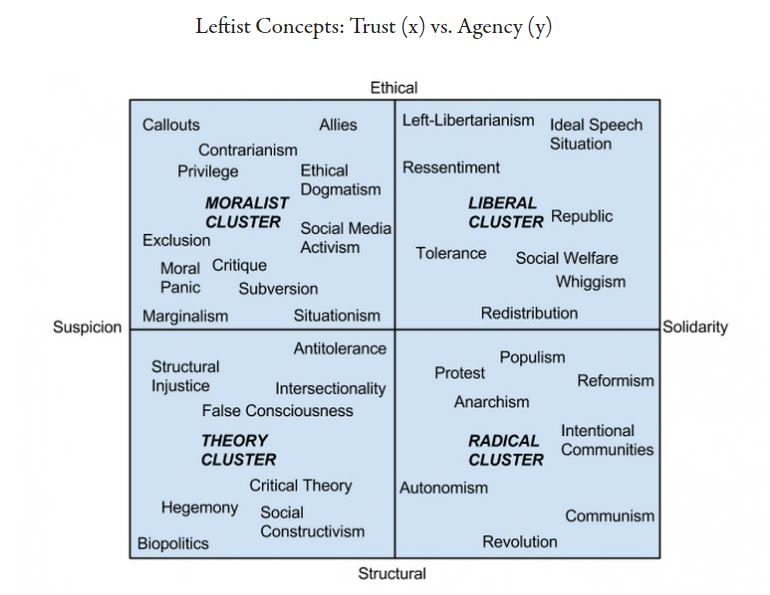
This shift, from a structural to an ethical view of human agency, is one of the most important shifts in leftist discourse in recent decades, shifting away from theories of radical change and toward the policing of individual human souls. I analyzed it in depth in #JeNeSuisPasLiberal: Entering the Quagmire of Online Leftism:
Leftism’s Embrace of Moralism
V.
The right, however, is prepared to give up on a lot more people as well, since their criteria is broader. I was struck, when I interviewed Newt Gingrich, by both his wild optimism as well as his indifference to individuals. He conceives of a future for the United States, but one that does not give much consideration to many of today’s (or tomorrow’s) Americans, who will be relegated to the dustbin of history. Like the tax bill, this attitude unnerves me. It utilizes Protestant moralism as a vehicle for anti-humanist socio-political engineering.
The trend that the more visionary Pruners see, I believe, is that both requirements for the functioning global economy may be put under pressure. Low growth and increasing automation will result in many, many more human lives becoming economically negligible. The long-term goal of Pruner Republican tactics is to “discourage” the propagation of “negative [human] assets” and ease these existing negative assets into death—by cutting their benefits and lifelines.
This, however, does set the stage for populist demagogues to appeal to pure resentment (racial or otherwise). Trump is a false prophet in this regard, as he is happy to go along with the Pruners’ plans, but also serves as a troubling augur—specifically, that Republican voters may continue to vote the wrong way in primaries. Which is yet another reason why the more visionary Pruner elites see it as increasingly urgent, via mechanisms such as the tax bill and court-packing, to kill the poor.
Appendix: The Hawk Calculus
One of the main themes of Thomas Piketty’s Capital in the 21st Century (my review here) is that there is a widespread belief in there being an ongoing, average 4% annual GDP growth. Piketty believes that the optimistic expectation of 4%, as opposed to the historical average of 2% over the last 200 years, is unwarranted, because the 4% average in the last half of the 20th century stemmed not from integral changes but from the massive asset destruction of World War II, which allowed subsequent reclamation in the post-war decades. He predicts a reversion to a 2% average and harsh adjustments relating to the reconfiguring of expectations: in particular a ballooning of inequality as investment return chronically exceeds real growth (his r > g formulation).
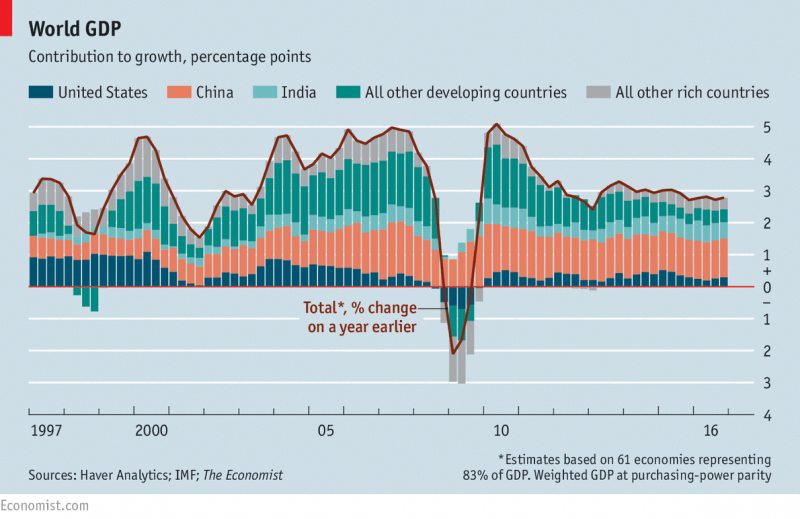
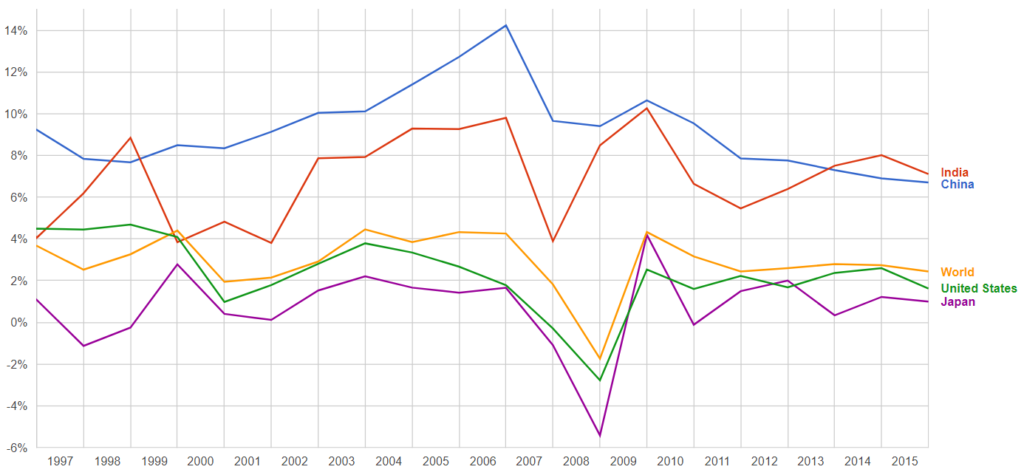
But even the calculation of GDP numbers is laden with uncertainty. The IMF claimed 3.2% global GDP growth in 2016. The World Bank claimed 2.4%. That’s a significant disparity, mostly owing to unreliable data from developing countries. But both put the United States and other developed countries as hovering around the 2% growth rate for the near term. These days, China contributes about 15% of global GDP (for comparison, the United States contributes around 23%), but China contributes a far larger proportion of global GDP hopes and expectations.
IMF: Real GDP Growth (%)
World Bank: Real GDP Growth (%)
One of the underlying causes in the shift in economic rhetoric over the last 25 years has been the declining contribution of US workers to global GDP. Initially, it fueled the push for globalization. Now, it fuels increasingly angry rhetoric on all sides. By itself, the proportion is not damning; GDP is always positive, after all. What gets economic hawks up in arms is when these numbers are weighed against government spending.
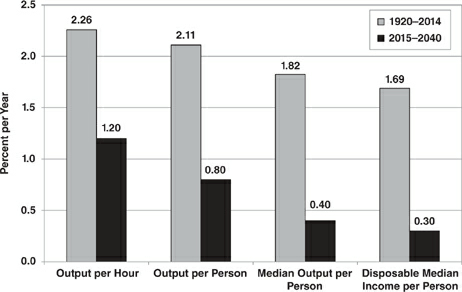
Ironically, the uptake from Piketty’s critique on the right has been to devalue lives. This makes sense given the hawkish tendency to see lives in terms of “human capital.” A graph like this, from Robert Gordon’s The Rise and Fall of American Growth, would appear to both Schumpeter and Karl Polanyi as an indicator of the limits of the growth-driven dynamo. But to the hawk, it only speaks to the need to streamline capitalism further. And “streamline” is a polite word.
Annual Growth Rate of Alternative Real Income Concepts, Actual Outcomes 1920–2014 and Projected Values 2015–2040 (Gordon)
Williamson’s attack on Garbutt, NY is based on the numbers showing that its residents consume more government money than they produce. Combined with the marginal and dwindling GDP contributions that left-leaning sorts like Piketty and Gordon anticipate, communities like Garbutt in Williamson’s view threaten the United States economically (by consuming resources better used toward growth) and electorally (by voting the wrong way). Their GDP contribution was the leavening ingredient that made them palatable to the hawks. As their productivity dwindles, they become increasingly malignant.