David B.: Two Stories

The Armed Garden and The Veiled Prophet appeared in the Winter and Spring/Summer issues of MOME, Fantagraphics’ otherwise unremarkable comics anthology. David B., though, is perhaps the greatest living comics writer/artist, and certainly the most mystical. His work draws heavily on portraying visual representations of internal and metaphysical states. He deployed these techniques at length in Epileptic (L’Ascension du Haut-Mal in French), his three-hundred hundred page chronicle of his brother’s severe epilepsy and his family’s life with it. At some point in the future, I will attempt to come to terms with the scope of David B.‘s achievement of creating a visual weltanschauung as universal as that of any of the old masters. Here, though, are two little religious fables about crossing the gap between the human and the heavens, and the horrors therein.

“The Armed Garden” is the more straightforward of the two. Jog describes it in detail here, but in brief, it concerns a Prague blacksmith, Rohan, who is subject to visions of Adam and Eve urging him to lead humanity back to paradise before the fall.
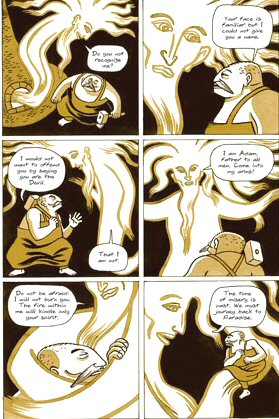
This he does, setting up camp in a verdant garden and descending into debauchery. One defiled woman under his reign asks, “You claim to be men of God, yet you commit the most abominable crimes,” and Rohan responds:

We are now one with God; we are no longer held to observe the commandments! We have the right to satisfy all our desires! If you refuse me, I shall kill you but you will be the one at fault!

Then the twist. Eve now appears to the militant Ziska, telling him, “Your brother Rohan has lost himself on the road to Paradise.” Ziska takes up arms and invades the garden, where they have regressed to a pre-human state of existence, having been absorbed into the trees, rocks, and ground. Rohan himself has undergone some kind of false apotheosis into a sun, and Ziska is able to destroy him with the aid of a talking goose.

Though the mythos is Christian, the story uses a more ancient mode of divine-human interaction that is closer to Greek and Norse mythology. Rohan loses the approbation of the gods even as he embraces their words and leaves humanity behind; it’s Ziska, who remains human, who comes out the victor, along with the backing of Eve.

“The Veiled Prophet” (also described by Jog) is very much the complement of “The Armed Garden”: this time, the divine intrudes on the human instead of the other way around. Set in a vaguely Arabic milieu, A veil falls from the sky onto an average man and transforms him into an all-purpose religious leader, appearing as any and all former prophets to others and inspiring an immediate and immense following. He amasses an army and sets about conquering all around him, until the Caliph marshals a large army against him. The prophet holds forth with rhetoric reminiscent of Rohan:

This world does not exist! It is an illusion! The real world is behind this veil. But you cannot see it without perishing! Here, there is neither law nor religion. The violation of every law is the first step toward the real world.

But unlike Rohan, the prophet is divine. He unleashes a literal flood of the skeletons of the victims and martyrs of injustice from all of history. The Caliph fights wisely and bravely, but he doesn’t have a chance. He’s only human.

The tenors of both stories are similarly folklorish, but the differences in setting and outcome are salutary. Reading “The Veiled Prophet” after “The Armed Garden,” I expected the prophet to come to grief, led astray by the intrusion of a piece of eternity—the veil—into the human world. But no, the prophet is now eternity (or the “real,” as the prophet would have it), and he is as destructive to the world as paradise was to Rohan’s sect. Humans touching eternity and eternity impinging on humans. David B.‘s cosmology in these two stories has the same axioms:

  1. The eternal world is more real than the human world.
  2. It is hostile to humans in its very nature.

This cosmology is a gnostic one in that the eternal world reveals itself subjectively and in pieces. Yet David B. seems ultimately concerned with the idea that it is precisely the illusory world that allows we as people to exist and to survive. Every incursion of the Real destroys us. Merely to touch the Real, as Ziska does at the end of “The Armed Garden,” is enough to blind one. People exist in the space between the Real and nothingness, condemned to see the world in lies and misunderstanding, and it is those fictions that form our very existence. Fictions keep the Real at bay, though it remains a constant presence. Hence the theme of compulsory, obsessive creation that underlies Epileptic.

In addition to gnosticism, it’s also a Hermetic metaphysic. Hermeticism thrives or dies based on the ability of its advocate to enthrall the aesthetic appreciation of the reader, and David B. is sublimely skilled in this regard. Hermeticism is particularly suited to the comics medium, just as Lull and Bruno communicated more intuitively and persuasively in their charts and graphics than they could in their writing.
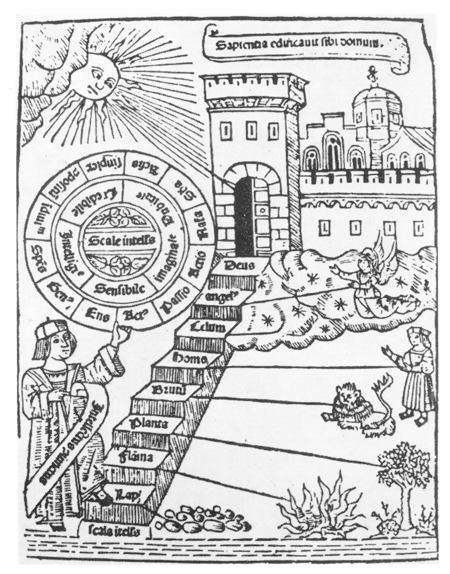
As for the source of David B.‘s inspiration, I can’t say, not being a gnostic or a hermeticist myself, but I cannot deny the overwhelming reaction (illusory or real) that his world (illusory or real) is more freestanding than those of most artists, requiring less support from the shared assumptions of his culture, and that this is a crucial aspect of at least one sort of genius.

27 August 2006, 15:11 |

Comments

  1. A great post and a great delight to see the image--from Frances Yates' book, right?--and to think about Hermeticism in relation to these texts. These artists who create their own worlds are immensely fascinating even though they seldom end up being my favorites.

    I went to Mass MoCA over the weekend and saw the Huang Yong Ping retrospective. He makes Bruno look simple--mixing Chinese with Western divination systems. Amazing and weird.

    — Anne · Sep 6, 06:00 PM · #

Textile Help

What's Missing from Finnegans Wake   |   Little Miss Sunshine


Search


Mail Waggish
RSS | Atom

MetaxuCafe

100 Most Recent Essays
  • John Williams: Stoner
  • Shchedrin: The Golovlyov Family
  • Donald Philip Verene: Knowledge of Things Actual And Divine
  • Southland Tales
  • Faulkner's Light in August and Coetzee's Disgrace
  • J.M. Coetzee: Diary of a Bad Year
  • Ernst Cassirer on Art Public and Private
  • P.F. Strawson: Freedom and Resentment
  • More on Gene Wolfe
  • Harry Partch: Delusion of the Fury
  • Gene Wolfe: The Book of the New Sun
  • Richard Hughes: A High Wind in Jamaica
  • Sellars on Following a Rule
  • Robert Walser: The Assistant
  • Occurrences at Owl Creek Bridge: Beyond the Zeroes
  • Carol Polsgrove on Ralph Ellison
  • Grondin on Gadamer
  • Occurrences at Owl Creek Bridge
  • Richard Rorty: Philosophy and the Mirror of Nature
  • Richard Rorty, 1931-2007
  • Jerry Fodor on Galen Strawson on Consciousness
  • Gadamer on Hegel and Language
  • Roberto Bolaño: Amulet
  • Hegel and Wittgenstein
  • Roberto Bolaño: The Savage Detectives
  • The Fall and Romanticism
  • Albert O. Hirschman: Exit, Voice, and Loyalty
  • Cesar Aira: An Episode in the Life of a Landscape Painter
  • Hegel's Conservatism (and McGoohan's Too)
  • Vladimir Sorokin: Ice
  • The Basic Conservatism of Hegel
  • Hegel and Stoicism
  • Kafka: Diogenes
  • Choose Your Own Philosophical Adventure #1: Escape from the Dialectic
  • Miklos Jancso: The Lord's Lantern in Budapest
  • Miklos Jancso: God Walks Backwards
  • Miklos Jancso: Winter Wind (Sirokko)
  • Fun with Consciousness
  • Magdalena Tulli: Moving Parts
  • Hugo von Hofmannsthal: An Incident...
  • Joanna Russ: We Who Are About To... [Die]
  • Finnegans Wake: The Book of Lists
  • Ecumenicality
  • David B.: Two Stories
  • What's Missing from Finnegans Wake
  • Laszlo Krasznahorkai: War and War
  • The Fifth Horseman is Fear
  • Christopher Priest: The Affirmation
  • Inquest on Left-Brained Literature
  • More Books on the (Finnegans) Wake
  • Carl Schmitt
  • Shohei Imamura 1926-2006
  • The Books on the (Finnegans) Wake
  • Gnostic Children's Books
  • Finnegans Wake and Little, Big
  • Reflections in/on Finnegans Wake
  • Godard: Masculin-Feminin
  • Dino Buzzati: The Tartar Steppe
  • Ilya Khrzhanovsky: 4 (Chetyre)
  • Stanislaw Lem (1921-2006)
  • Anne Stevenson: In the Museum of Floating Bodies and Flammable Souls
  • Hiroshi Teshigahara: The Face of Another
  • Samuel Beckett: How It Is & Ping
  • Elaine May: A New Leaf
  • Bela Tarr: Satantango [3]
  • J.M. Coetzee: Slow Man
  • Harold Brodkey
  • Bela Tarr: Satantango [2]
  • Bela Tarr: Satantango
  • Gabriel Josipovici: In a Hotel Garden
  • Erich Auerbach: Mimesis 1
  • Samuel Delany: The Motion of Light in Water
  • Yasunari Kawabata: The Sound of the Mountain
  • Keiho Oguri: Sting of Death
  • Aleksandr Sokurov: The Sun
  • Samuel Beckett: Watt
  • A la Fin Du Temps Perdu
  • John Crowley: Great Work of Time
  • David Grossman: See Under: Love
  • Alain Resnais: Night and Fog
  • Albert O. Hirschman: The Passions and the Interests
  • Denis Diderot: Rameau's Nephew
  • Gabriel Josipovici on Grimm and Kleist
  • Shaviro on Schumpeter
  • Thoughts on Genre: Blogs and Practice
  • Thoughts on Genre: Blogs and Improvisation
  • Thoughts on Genre: Blogs and Genre
  • Thomas Bernhard: Extinction
  • Strawson on Consciousness
  • Thoughts on Genre: Hitsville, Dullsville
  • Thoughts on Genre: Exceptional Science Fiction
  • Thoughts on Genre: The Secret of Comedy (circa 1935)
  • J.M. Coetzee: Elizabeth Costello
  • Thoughts on Work
  • Jean Eustache: The Mother and the Whore
  • Brett Bourbon: Finding a Replacement for the Soul, cont.
  • Adolescence
  • Jacques Becker
  • Brett Bourbon: Finding a Replacement for the Soul, cont.
  • Brett Bourbon: Finding a Replacement for the Soul

Work in Progress
  • Waggish Reads Proust
  • The Novel: 206,000 (first draft finished)

Comment
  • nightspore (Sellars on Kant)
  • Mr. Waggish (Sellars on Kant)
  • nightspore (Montaigne: On Democritus and Heraclitus)
  • nightspore (Sellars on Kant)
  • peli grietzer (Sellars on Kant)
  • Mr. Waggish (Iannis Xenakis: Free Stochastic Music By Computer)
  • dan visel (Iannis Xenakis: Free Stochastic Music By Computer)
  • Sherlock Jr. (John Williams: Stoner)
Please Read
  • Cahiers de Corey
  • charlotte street
  • Chekhov's Mistress
  • Complete Review
  • Dispatches from Zembla
  • Eudaemonist
  • Even Unto Thy Shoes
  • The Existence Machine
  • Flowerville
  • Fortunes of the Dialectic
  • Geegaw
  • Gentle Reader
  • Golden Rule Jones
  • Le Colonel Chabert
  • Mumpsimus
  • Nightspore
  • pas au-dela
  • Pseudopodium
  • The Reading Experience
  • ReadySteadyBook
  • scarecrow
  • snarkout
  • Spurious
  • Stochastic Bookmark
  • Tabula Rasa
  • This Public Address
  • This Space
  • Three-Toed Sloth
  • With Hidden Noise
  • wood s lot

Credits
  • Banner by David B
  • Design by geegaw
  • CSS by snarkout
  • CMS by Textpattern

Archives
  • January 2003
  • February 2003
  • March 2003
  • April 2003
  • May 2003
  • June 2003
  • September 2003
  • October 2003
  • November 2003
  • December 2003
  • January 2004
  • February 2004
  • March 2004
  • April 2004
  • June 2004
  • September 2004
  • October 2004
  • November 2004
  • December 2004
  • January 2005
  • February 2005
  • March 2005
  • April 2005
  • May 2005
  • June 2005
  • July 2005
  • August 2005
  • September 2005
  • October 2005
  • November 2005
  • December 2005
  • January 2006
  • February 2006
  • March 2006
  • April 2006
  • May 2006
  • June 2006
  • July 2006
  • August 2006
  • September 2006
  • October 2006
  • November 2006
  • December 2006
  • January 2007
  • February 2007
  • March 2007
  • April 2007
  • May 2007
  • June 2007
  • July 2007
  • August 2007
  • September 2007
  • October 2007
  • November 2007
  • December 2007
  • January 2008
  • February 2008
  • March 2008
  • April 2008
  • May 2008
  • June 2008
  • July 2008