Waggish

David Auerbach on literature, tech, film, etc.

Tag: literature (page 30 of 86)

Sellars on Kant

When Kant insists that we ought to act from a sense of duty he is not making the absurd mistakes which have often been attributed to him. He is simply repeating the point with which he opens the argument of the Fundamental Principles of Metaphysic of Morals, that the only unconditional good is a good will. By this he means that the only state of a person which is unconditionally good from a moral point of view is the disposition to act from a sense of duty. He has two points in mind: (a) Whereas action from any motive can have bad results, the sense of duty alone is such that only by virtue of ignorance does it have bad results. Action from other motives even where ignorance is absent can lead to bad results. Thus the sense of duty is the only motive which has a direct conceptual tie to the categorically valid end of moral conduct. In this sense a good will is a categorical ought-to-be. (b) Although the general welfare is also an end in itself, a categorical ought-to-be, the ought-to-be of the happiness of any given individual is, Kant believes, conditional on his having a good will.

Wilfrid Sellars, Form and Content in Ethical Theory

It’s still hard for me to see how this is not question-begging or even circular. Sellars wants to bring in specificity to the data on which the good will acts, but this poses the problem of whether the good will obtains its disposition from this data (in which case the will is not unconditioned), or whether the disposition is innate and/or noumenal, in which case the will still has the capacity to act in a state of complete ignorance and still be acting from the sense of duty.

It was Sellars’s goal to merge scientific reality with phenomenological experience by offering a constructivist account of how our conceptual knowledge of the latter emerges without appealing to any pie-in-the-sky Platonism. Since Sellars’s problem was not with a priori knowledge in the Kantian sense per se (whether he would term this knowledge is a different question entirely), he would not have to necessarily be opposed to a naturalistic conception of morality, i.e., one that could fit within the scientific image. This is why he can say that for Kant, “The fallibility of moral philosophy is not the fallibility of empirical induction,” because morality need not be obtained from empirical induction. Consequently, Kant ends up doing a bit of Sellars’s work for him if Sellars can accept that the good will obtained in such a way fulfills the criteria required for a moral authority.
Montaigne: On Democritus and Heraclitus

Democritus et Heraclitus ont esté deux philosophes, desquels le premier trouvant vaine et ridicule l’humaine condition, ne sortoit en public, qu’avec un visage moqueur et riant : Heraclitus, ayant pitié et compassion de cette mesme condition nostre, en portoit le visage continuellement triste, et les yeux chargez de larmes.

alter
Ridebat quoties à limine moverat unum
Protuleratque pedem, flebat contrarius alter.

Juvenal

J’ayme mieux la premiere humeur, non par ce qu’il est plus plaisant de rire que de pleurer : mais par ce qu’elle est plus desdaigneuse, et qu’elle nous condamne plus que l’autre : et il me semble, que nous ne pouvons jamais estre assez mesprisez selon nostre merite. La plainte et la commiseration sont meslées à quelque estimation de la chose qu’on plaint : les choses dequoy on se moque, on les estime sans prix. Je ne pense point qu’il y ait tant de malheur en nous, comme il y a de vanité, ny tant de malice comme de sotise : nous ne sommes pas si pleins de mal, comme d’inanité : nous ne sommes pas si miserables, comme nous sommes vils.

(Translation available here.)

Category Mistake!

It seems to me that none of these interpretations [of quantum theory] is at all satisfactory, and in the gap left by the failure to ?nd a sensible way to understand quantum reality there has grown a pathological industry of pseudo-scienti?c gobbledegook. Claims that entanglement is consistent with telepathy, that parallel universes are scienti?c truths, that consciousness is a quantum phenomena abound in the New Age sections of bookshops but have no rational foundation. Physicists may complain about this, but they have only themselves to blame.

But there is one remaining possibility for an interpretation that has been unfairly neglected by quantum theorists despite—or perhaps because of—the fact that it is the closest of all to commonsense. This view that quantum mechanics is just an incomplete theory, and the reason it produces only a probabilistic description is that it does not provide suf?cient information to make de?nite predictions. This line of reasoning has a distinguished pedigree, but fell out of favour after the arrival of Bell’s theorem and related issues. Early ideas on this theme revolved around the idea that particles could carry ‘hidden variables’ whose behaviour we could not predict because our fun- damental description is inadequate. In other words two apparently identical electrons are not really identical; something we cannot directly measure marks them apart. If this works then we can simply use only probability theory to deal with inferences made on the basis of our inadequate information. After Bell’s work, however, it became clear that these hidden variables must possess a very peculiar property if they are to describe our quantum world. The property of entanglement requires the hidden variables to be non-local. In other words, two electrons must be able to communicate their values faster than the speed of light. Putting this conclusion together with relativity leads one to deduce that the chain of cause and effect must break down: hidden variables are therefore acausal. This is such an unpalatable idea that it seems to many physicists to be even worse than the alternatives, but to me it seems entirely plausible that the causal structure of space-time must break down at some level. On the other hand, not all ‘incomplete’ interpretations of quantum theory involve hidden variables.

One can think of this category of interpretation as involving an epistemological view of quantum mechanics. The probabilistic nature of the theory has, in some sense, a subjective origin. It represents de?ciencies in our state of knowledge. The alternative Copenhagen and Many-Worlds views I discussed above differ greatly from each other, but each is characterized by the mistaken desire to put quantum probability in the realm of ontology.

Peter Coles, From Cosmos to Chaos

I am far too ignorant to say how plausible Coles’s thesis is, other than that acausality doesn’t seem any less plausible than decoherence or Everett’s multiple-worlds. And it has the side effect of delegitimizing one of the most overused scientific metaphors of our time. (The most egregious example offhand being Michael Frayn’s Copenhagen.)

John Williams: Stoner

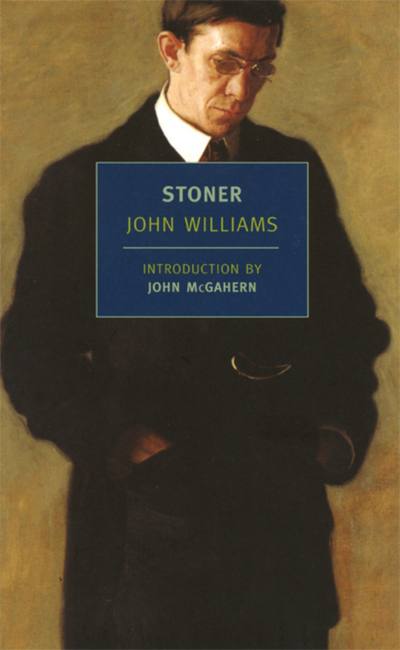
Whatever my reservations about the New York Review of Books, if it subsidizes reissues of things like this, I pardon its sins. Extra points for choosing such an apt cover painting to implicitly portray its hapless professor hero:


And here is Stoner speaking:

Stoner looked across the room, out of the window, trying to remember. “The three of us were together, and he said–something about the University being an asylum, a refuge from the world, for the dispossessed, the crippled. But he didn’t mean Walker. Dave would have thought of Walker as–as the world. And we can’t let him in. For if we do, we become like the world, just as unreal, just as…The only hope we have is to keep him out.”

Walker is an ignorant, smooth-talking, careerist academic, and there’s little separating his portrayal in this book (from 1965, but taking place mostly in the first half of the century) from these sorts of people today. Stoner is an impractical dreamer, a farmboy who goes to a local college and discovers he loves literature, and so does his graduate work at the same school and then gets a professorship there. He makes two mistakes: he marries the wrong woman, and he makes the wrong enemy in his department. These are big mistakes, and he pays big for them.

I cannot recall any other academic novel that treats its subject material with such unremitting gravity. The standard model of an academic novel is to either indulge in high melodrama (Mary McCarthy, Iris Murdoch) or to make light of the intellectual pretenses of its characters (Kinsley Amis’s overrated Lucky Jim, Malcolm Bradbury’s far funnier Stepping Westward). Williams’s approach seems to have been to adopt the social realist approach of George Gissingand Sinclair Lewis’s more sober moments and apply it to the incongruous and hermetic world of a university. Consequently, he treats the small events of Stoner’s life with a sense of real consequence, as though they were matters of life and death. And so they become.

After his mistakes, Stoner is a defeated man, and it takes him years to recover. But what saves the novel from being just an exercise in misery is that Stoner does get his triumph. He fights against the inertial decline of his life, and he wins. It is, objectively speaking, a small triumph, but on the terms that Williams has set, it validates his existence without qualification. The novel is a passage from ideals that cannot be fulfilled to a non-tragic view of life, and it’s summarized best in this passage:

In his extreme youth Stoner had thought of love as an absolute state of being to which, if one were lucky, one might find access; in his maturity he had decided it was the heaven of a false religion, toward which one ought to gaze with an amused disbelief, a gently familiar contempt, and an embarrassed nostalgia. Now in his middle age, he began to know that it was neither a stae of grace nor an illusion; he saw it as an act of becoming, a condition that was invented and modified moment by moment and day by day, by the will and the intelligence and the heart.

I don’t mean to downplay the brutally accurate portrayals of academic politics and fleeting trends, which feel absolutely au courant, but the novel would not stand out as it does if it did not treat its subject matter with the same respect and humility with which Stoner himself treats literature and teaching.

Shchedrin: The Golovlyov Family

It must not be imagined that Iudushka was a hypocrite in the same sense as Tartuffe or any modern French bourgeois who goes off into flights of eloquence on the subject of social morality. No, he was a hypocrite of a purely Russian sort, that is, simply a man devoid of all moral standards, knowing no truth other than the copy-book precepts. He was pettifogging, deceitful, loquacious, boundlessly ignorant, and afraid of the devil. All these qualities are merely negative and can supply no stable material for real hypocrisy.

In France hypocrisy is the outcome of a man’s upbringing; it forms part of “good manners” so to speak, and almost always has a distinct political or social coloring…If this kind of hypocrisy cannot be described as a conviction, it is in any case a banner around which men who find it profitable to be hypocritical in this rather than in some other way can gather. They are conscious hypocrites, that is, they know it themselves and are aware that other people know it too. For a French bourgeois the universe is nothing but a large theater in which an endless play is going on and one hypocrite gives his cue to another.

We Russians have no strongly biased systems of education. We are not drilled, we are not trained to be champions and propagandists of this or that set of moral principles but are simply allowed to grow as nettles grow by a fence. This is why there are very few hypocrites among us and very many liars, bigots, and babblers. We have no need to be hypocritical for the sake of any fundamental social principles, for we have no such principles and do not take shelter under any one of them. We exist quite freely, i.e. we vegetate, babble, and lie spontaneously, without any principles.

Whether this is a matter for grieving or rejoicing is not for me to say. I think, however, that while hypocrisy may arouse fear and indignation, objectless lying makes one feel bored and disgusted. And so the best thing is not to discuss the advantages or disadvantages of the conscious as compared with the unconscious hypocrisy, but to keep away both from hypocrites and from liars.

And so Iudushka was a sneak, a liar, and a babbling fool rather than a hypocrite….

The Golovlyov Family (1876)

And so, like a sober, humorless Gogol, Shchedrin sets about proving his point, not just by portraying these characters in unrelentingly brutal detail, but by killing them off rather arbitrarily. In Dostoevsky and in Tolstoy, characters do tend to stick around so they can meet a fate, deserved or undeserved, that serves some dramatic or moral purpose. Shchedrin kills off characters prematurely to foreclose any possibility of redemption, though it quickly becomes clear there was never a chance anyway. What begins as a character sketch ends with that same character dying. Even by Russian standards, this is a miserable book.

I don’t know if Shchedrin had read Burke or Diderot, to whom he seems to be responding here, but his point that hypocrisy implies a bourgeois sort of moral self-awareness is well-taken, and I would say I see Shchedrin’s sort of hypocrite a lot more often than Rameau’s Nephew.

« Older posts Newer posts »

© 2026 Waggish

Theme by Anders NorenUp ↑