Waggish

David Auerbach on literature, tech, film, etc.

Category: Miscellania (page 4 of 108)

David Quint on Structuralism and New Historicism and Theory in General

David Quint, in his estimable book Epic and Empire, argues against the totalizing tendency of much literary theory and criticism of the 20th century. He speaks of poststructuralism and New Historicism but the general argument could apply to any number of other theories as well. (This is, essentially, what I criticized Derrida for doing in his attack on Husserl.)

I register here my methodological distance from, while acknowledging my indebtedness to, a poststructuralist critical practice that, in turning literary studies back toward history, has incorporated the models of structuralist anthropology. In this line of work, which is sometimes broadly called New Historicism, the literary text is one of an array of cultural products that share a single deep structure or mentality.

My reservations about this practice are partly conditioned by the more local explanations I have arrived at concerning epic and its relationship to the political order. In the widely conceived web of intertextual relationships that constitute the structuralist-historicist slice of history—in which all components of the culture are presupposed to develop at more or less the same rate at any historical moment—the literary text seems capable of being linked with almost any other text of the culture, and there appears to be no control to determine the juxtaposition. The text’s own explicit allusive network becomes only one element of this intertextuality, and certainly not a privileged one. Politics, too, the social disposition of coercive power, becomes one more product of this patterned mentality or “poetics.” That is, politics is necessarily aestheticized by the interpreter. It is one thing to acknowledge that power to some degree depends on the manipulation of semiotic and symbolic order—I do, in fact, argue this—but quite another to conflate the two.

Furthermore, attention to synchronous historical relationships can cause the text’s participation in a diachronic literary history to be overlooked.

David Quint, Epic and Empire (14)

Similar points have been made by many critics of such overarching theories, but this is the most compact statement of the critique that I’ve seen, so I thought it deserved quoting. The underlying irony Quint seems to emphasize is that the conflation of power and semiotics is, in fact, a semiotic power grab.

New Articles on Computers and Culture

n+1 has posted roughly the first third of my article The Stupidity of Computers online. It talks about what computers can do easily, and what is near-impossible for them.


The Stupidity of Computers


Computers are near-omnipotent cauldrons of processing power, but they’re also stupid. They are the undisputed chess champions of the world, but they can’t understand a simple English conversation. IBM’s Watson supercomputer defeated two top Jeopardy! players last year, but for the clue “What grasshoppers eat,” Watson answered: “Kosher.” For all the data he could access within a fraction of a second—one of the greatest corpuses ever assembled—Watson looked awfully dumb….

Some of the towering achievements in computer science have been in the creation of brilliantly clever, efficient, and useful algorithms such as Quicksort, Huffman Compression, the Fast Fourier Transform, and the Monte Carlo method, all reasonably simple (but not obvious) methods of accomplishing precisely specified tasks on potentially huge amounts of precisely specified data. Alongside such computational challenges there has been the dream of artificial intelligence: to get computers to think….


It has a bit of the history of artificial intelligence, which one rather famous AI researcher has called “a history of failure,” including SHRDLU, ELIZA, and MGonz. (For more details, see Mark Humphrys’ paper “How My Program Passed the Turing Test.”)

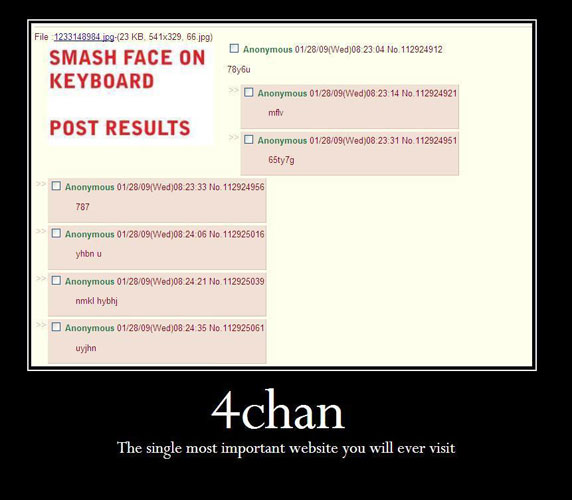
I also have a long feature on “A-culture” (anonymous internet culture: 4chan, Anonymous, etc.) now up at the online magazine Triple Canopy. It is in two parts, beginning with an essay:


Anonymity as Culture: Treatise

Alienation, irony, autonomy, discourse. On 4chan and Internet masquerade.

4chan

It gets worse.

Today, the most ubiquitous online communities are social networks where our identities are mostly known and mostly persistent. Each tweet, each status update, is branded with a persistent name or affiliation.

Yet for people who do not want to be known, do not want to be corralled into demographic groups, and do not want the hierarchy of prestige, other spaces persist. These are the sort of spaces that were the progenitors of social networks: newsgroups, chatrooms, online forums, and Internet Relay Chat channels. They offer a lack of accountability for what one says, a way to hide unappealing facts about oneself, and an instant escape hatch if things get unpleasant. They offer anonymity.

The growth of these anonymous spaces marks the first wide-scale collective gathering of those who are alienated, disaffected, voiceless, and just plain unsocialized….


Delve then, if you dare, into the glossary and case studies:


Anonymity as Culture: Case Studies

Homosexuality, suicide, hate, porn. Four episodes and a glossary.

trap

A trap can never be obvious, or else it isn’t a trap.

Transgenderism is one of the recurrent obsessions of A-culture—specifically the idea of the trap, i.e., a male who presents himself as a woman and would be taken for a woman except for his genitals. The phrase—taken from Admiral Ackbar’s exclamation on being ambushed in Return of the Jedi: “It’s a trap!”—is a pejorative indicating that straight men have been tricked into being aroused by one of their own gender. However, it’s not unusual for posters to identify themselves as traps, or for posters to declare an interest in traps and even express confusion over their attraction to them. The trap embodies two conflicting impulses of A-culture: the love of deviancy and surprise, and the pervasiveness of suspicion, deception, and ridicule. This paradox is best exemplified by the posting of the technically self-contradictory statement “I’m a trap.”

I wrote this article in the spirit of Erving Goffman.

Two Daughters: On Pilar Donoso

Normal posting should resume soon after I finally clear through  an especially bad new year crunch, but I do have a piece up at n+1 about Jose Donoso’s daughter Pilar, author of the recent memoir of her family, Drawing the Veil.

Two Daughters

Two daughters bookended my year. One is Pilar Donoso, daughter of the great Chilean writer Jose Donoso (1924–1996). Fellow Chilean Roberto Bolaño called Donoso easily the greatest Chilean novelist of the century. I have long thought Donoso’s The Obscene Bird of Night (1970) to be one of the greatest novels of the 20th century, besting the better-known novels of the Latin American Boom. It is a phantasmagoric, surreal, and narratively unstable book that combines folklore, horror, and political and familial corruption to create an allegory of artistic creation, which is embodied by the central figure of the imbunche, a troll-like monster in Chilote mythology whose body is folded in on itself, with all its orifices sewn shut.

While researching an article on Donoso, I discovered that his daughter Pilar had written a book called Correr el tupido velo (Drawing the Veil), which was published in 2009. A sort of posthumous collaboration with her father, it tells the story of his life by drawing on her own memories as well as her father’s diaries, released only after his death in 1996. A chronicle of her father’s torment, paranoia, self-hatred, and mistreatment of his family, as well as his deeply closeted homosexuality,Drawing the Veil is all the more uncanny for its echoes of the blatantly anti-realisticThe Obscene Bird of Night, in which boys try to take revenge on their fathers by writing their biographies: a central theme of the book is the conceptual and emotional prisons made for us by our parents. Donoso later wrote, “This novel, which took me about eight years to write, is one and the same in my memory with the experience of pain and disease.”

The book was not Pilar Donoso’s idea; her father asked her to be his biographer. It took her seven years to write, and after publication, her marriage fell apart and her children went with their father rather than her. Pilar Donoso said the book destroyed her family, but that writing it was a necessary catharsis. She also said that she did not consider herself a victim. In November, after I finished the article, Pilar Donoso was found dead by her own hand. The obituaries mentioned a passage late in her father’s diaries in which he sketched out a story about the daughter of a deceased writer who reads and publishes her father’s diaries and then commits suicide.

The second daughter is my own, born at the beginning of the year. The next decades of my life have now been partly written: I have and will always be this child’s father. As I’ve grown attuned to this new being who changes, inexorably, far faster than anything else around me, I’ve crossed from the Brooklyn world of professionals, artists, and hipsters into the separate but consubstantial world of parents and children. I now feel the constant presence of her and other inchoate creatures who unconsciously absorb every hidden meaning and motive of those around them.

I am writing my daughter’s life, knowing I must make room for her to do so herself when she is able—knowing I must be careful. Pilar Donoso wrote, “One should not know the intimate thoughts of anyone. Least of all those of one’s own parents.” I wonder what thoughts I may need to hide from her so that she will be able to expand out into the world and not fold up into a void. I hope I will be able to do so.

Books of the Year 2011

Here is a quick rundown of new books, reissues, and assorted other things that I especially enjoyed this year which also happened to be published this year. They aren’t in any particular order, though fiction is more toward the top and nonfiction toward the bottom. Imre Kertesz’ Fiasco stands out as perhaps the most significant to me of the lot.

I’m using Amazon integration not because of any strong desire to do so, but because I could not find another tool that allowed me to list a collection easily and had access to the covers and data for most of the books on the list. I’m not making any affiliate money whatsoever from this. The links are there for convenience only.

Even still, there are missing books. One is Wendy Walker’s mysterious, uncanny My Man and Other Critical Fictions.

Correr el tupido velo

Price: $14.55

1 used & new available from

MOONSHADOWS: Conventional Truth in Buddhist Philosophy

Price: $40.82

2 used & new available from $22.00

Peirce and the Threat of Nominalism

Price: $64.02

1 used & new available from $64.02

Shakespeare Studies Today: Romanticism Lost

Price: $47.32

1 used & new available from $47.32

After Godel: Platonism and Rationalism in Mathematics and Logic

Price: $50.00

1 used & new available from $50.00

A History of Renaissance Rhetoric, 1380-1620 (Oxford-Warburg Studies)

Price: $160.00

2 used & new available from $97.77

The Bodhisattva's Brain: Buddhism Naturalized

Price: $187.80

2 used & new available from $8.41

Keep The Giraffe Burning

Price: ---

0 used & new available from

Rhetorical Style: The Uses of Language in Persuasion

Price: $48.56

2 used & new available from $17.79

Three Days Before the Shooting . . .

Price: $14.98

1 used & new available from

The Letters of Samuel Beckett: Volume 2, 1941–1956

Price: $37.68

2 used & new available from $28.90

Age of Fracture

Price: $19.99

2 used & new available from

Gender City

Price: $20.00

1 used & new available from $20.00

Anew: Complete Shorter Poetry

Price: $18.59

1 used & new available from $18.59

The Guinea Pigs

Price: $8.99

1 used & new available from $8.99

Ice Trilogy (New York Review Books Classics)

Price: $19.95

2 used & new available from $12.54

Who Was Changed and Who Was Dead

Price: $12.91

1 used & new available from $12.91

Black Paths

Price: $17.57

2 used & new available from $7.09

The Armed Garden And Other Stories

Price: ---

0 used & new available from

The Lizard's Tale: A Novel

Price: $27.95

2 used & new available from $16.77

Thésée universel

Price: $25.47

1 used & new available from $25.47

AnimalInside (The Cahiers)

Price: $496.01

1 used & new available from

Cedilla

Price: $41.95

2 used & new available from $38.95

War Diary (The German List)

Price: $19.98

1 used & new available from

Fiasco

Price: $23.04

1 used & new available from

Robert Musil: from the Diaries

13 August 1910. Before I went to sleep, one or two other things occurred to me about my way of working (in the novellas). What matters to me is the passionate energy of the idea. In cases where I am not able to work out some special idea, the work immediately begins to bore me; this is true for almost every single paragraph. Now why is it that this thinking, which after all is not aiming at any kind of scientific validity but only a certain individual truth, cannot move at a quicker pace? I found that in the reflective [gedanklich] element of art there is a dissipative momentum — here I only have to think of the reflections that I have sometimes written down in parallel with my drafts. The idea immediately moves onward in all directions, the notions go on growing outward on all sides, the result is a disorganized, amorphous complex. In the case of exact thinking, however, the idea is tied up, delineated, articulated, by means of the goal of the work, the way it is limited to what can be proven, the separation into probable and certain, etc., in short, by means of the methodological demands that stem from the object of investigation.

In art, this process of selection is missing. Its place is taken by the selection of the images, the style, the mood of the whole.

I was annoyed because it is often the case with me that the rhetorical precedes the reflective. I am forced to continue the inventive process after the style of images that are already there and this is often not possible without some amputation of the core of what one would like to say — as, for instance, with The Enchanted House or The Perfection of a Love. I am only able at first to develop the thought-material for a piece of work to a point that is relatively close by, then it dissolves in my hands. Then the moment arrives when the work in hand is receiving the final polish, the style has reached maturity, etc. It is only now that, both gripped and constrained by what is now in a finished state, I am able to “think” on further.

There are two opposing forces that one has to set in balance — the dissipating, formless one from the realm of the idea and the restrictive, somewhat empty and formal one relating to the rhetorical invention.

One only says what one can say within the frame of what is available; since the point of departure is arbitrary there is an element of chance about it. But the point of departure is not absolutely arbitrary, for the first images are after all products of a tendency that, hovering before one’s eyes, sets the direction for the whole work.

Tying this together to achieve the greatest degree of intellectual compression, this final stepping beyond the work in accordance with the needs of the intellectual who abjures everything that is mere words, this intellectual activity comes only after these two stages. Here the effect of the understanding is astringent, but here it is directed toward the unity of form and content that is already present whereas, whenever it is merely a question of thinking out the content, it dissipates. (Even in cases where one already has the basic idea around which everything is to be grouped, as long as the capacity for creating images is missing it will not work; if one restricts oneself in the extensive mode one goes too far in the intensive mode and one becomes amorphous.)

Robert Musil, Diaries, Notebook 5 (tr. Payne)

« Older posts Newer posts »

© 2026 Waggish

Theme by Anders Noren — Up ↑