It was a pretty good year, especially for fiction. I stand no chance of ever catching up on my backlog of books to read, so these are less “Books of the Year” than “Books of My Year,” ones which happened to be published in 2013 (or late 2012). A boom in non-Waggish writing resulted in me not having time to write up some of these books, which I really do regret. I spent a month rereading old Pynchon novels alongside Bleeding Edge, which was blessedly worthwhile, but did not help my productivity. Reading list longa, vita brevis.
The order is fairly random though I have tried to put my favorites toward the top of each section. Krasznahorkai’s Seiobo was probably foreordained to be at the top, while the final appearance of Lem’s Summa Technologiae in English was a major event for me. (See my review here.) As with War and War when I first read it, I don’t have a lot to say about Seiobo right now. Maybe in ten years.
As with last year, I haven’t read the entirety of some of the nonfiction selections: Judith Herrin’s two volumes of essays will take some time, while the Maimonides book had me flagging on several topics that just aren’t my thing.
If anyone’s curious as to why some book or other made the list, feel free to ask in the comments. Thanks again for reading my work here or elsewhere.
(As always, I do not make any money from these links; they’re just the easiest way to get the thumbnails.)
John Marston was one of the nastier Renaissance playwrights, and his lack of restraint eventually appears to have gotten him in so much trouble that he had to leave the stage altogether and enter the clergy. His play The Malcontent, which was probably performed in 1603 and then published in 1604, is a severe melodrama of a deposed Duke, Altofronto, grouchily plotting to regain his rulership by pretending to be a truth-telling counselor and misanthrope–named Malevole, just to make that point clear–and bringing out the worst tendencies of those in the court. They don’t need much encouragement, since the court’s “minion” Mendoza, who is sleeping with the current Duke’s wife, has plenty of Machiavellian plans of his own, and Altofronto/Malevole just needs to tap him to push him over the precipice. The expected “happy ending” is more reassuring than that of Measure by Measure, but even less convincing.
But there are two poetic, though somewhat out of place, soliloquys reflecting on the wretchedness of man that caught my attention. They have the typical gnarled flow of Marston’s prose, which seems to be closer to its Roman Silver Age antecedents than anyone else’s (Seneca was a huge influence at the time). And thanks to the notes of G. K. Hunter in my Revels edition, I see that both speeches were adapted from a single source: Joshua Sylvester’s translation of Du Bartas’ epic religious poems. Marston alters them both in style and tone, but he appropriates structure and imagery freely. The first invokes the title of the play and is a looser borrowing:
JOHN MARSTON, THE MALCONTENT III.ii
MALEVOLE I cannot sleep ; my eyes’ ill-neighbouring lids Will hold no fellowship. O thou pale sober night, Thou that in sluggish fumes all sense dost steep ; Thou that giv’st all the world full leave to play, Unbend’st the feebled veins of sweaty labour! The galley-slave, that all the toilsome day Tugs at his oar against the stubborn wave, Straining his rugged veins, snores fast ; The stooping scythe-man, that doth barb the field. Thou mak’st wink sure : in night all creatures sleep ; Only the malcontent, that ‘gainst his fate Repines and quarrels, — alas, he’s goodman tell-clock ! His sallow jaw-bones sink with wasting moan ; Whilst others’ beds are down, his pillow’s stone.
DU BARTAS, THE FIRST DAY OF THE FIRST WEEK, tr. JOSHUA SYLVESTER
The Night is she, that with her sable wing, In gloomy Darkness hushing every thing, Through all the World dumb silence doth distill, And wearied bones with quiet sleep doth fill. Sweet Night, without Thee, without Thee, alas, Our life were loathsome; even a Hell to pass. …… He that, still stooping, tugs against the tide His laden barge alongst a River’s side, And filling shores with shouts, doth melt him quite ; Upon his pallet resteth yet at Night. He, that in summer, in extremest heat Scorched all day in his own scalding sweat, Shaves with keen Scythe, the glory and delight Of motley meadows ; resteth yet at night, …… Only the learned Sisters’ sacred Minions, While silent Night under her sable pinions Folds all the world, with painless pain they tread A sacred path that to the Heavens doth lead.
Where he borrows images, Marston sharpens the prose: “The galley-slave…tugs at his oar against the stubborn wave” in Sylvester becomes “He that, still stooping, tugs against the tide” in Marston. “He that shaves with keen scythe the glory and delight of motley meadows” becomes “The stooping scythe-man that doth barb the field.” The drastic difference is that into Du Bartas’ picture of sleep’s respite from the cruel world, Marston injects the malcontent, “goodman tell-clock,” who can’t sleep. (I admit I don’t know what Sylvester is getting at with “painless pain.”)
The second speech is more unquestionably plagiaristic. It is delivered by Pietro, Malevole’s successor and target. Pietro, here, is describing to his wife Aurelia the terrible hell she’s brought to him by sleeping with Mendoza.
JOHN MARSTON, THE MALCONTENT IV.v
PIETRO My cell ’tis, lady ; where, instead of masks, Music, tilts, tourneys, and such courtlike shows, The hollow murmur of the checkless winds Shall groan again ; whilst the unquiet sea Shakes the whole rock with foamy battery. There usherless the air comes in and out : The rheumy vault will force your eyes to weep, Whilst you behold true desolation : A rocky barrenness shall pierce your eyes. Where all at once one reaches where he stands, With brows the roof, both walls with both his hands.
DU BARTAS, THE FIRST DAY OF THE SECOND WEEK, tr. JOSHUA SYLVESTER
Who, Full Of wealth and honour’s blandishment, Among great Lords his younger years hath spent ; And quaffing deeply of the Court-delights, Us’d nought but tilts, tourneys, and masks, & sights – If in his age his Prince’s angry doom With deep disgrace drive him to live at home In homely cottage, where continually The bitter smoke exhales abundantly From his before-un-sorrow-drained brain The brackish vapours of a silver rain : Where usherless, both day and night, the North, South, East and West winds enter and go forth, Where round-about, the low-roofed broken walls Instead of Arras hang with Spiders’ cauls, Where all at once he reacheth as he stands. With brows the roof, both walls with both his hands.
This Sylvester source passage is far harsher than the earlier, with knottier syntax to match. (“His before-un-sorrow-drained-brain” seems worthy of Marston. Or Robert Walser.) The context is a long simile for the expulsion from Eden, comparing it to a Prince who’s been reduced to living in poverty. Again, Marston roughs up Sylvester (Marston gets a “rheumy vault” out of Sylvester’s “homely cottage”), but Sylvester has already done half the work in making his prose so jagged. Marston had far less distance to go in adapting it into his style. The final image, of the inhabitant virtually trapped in a tiny room no taller nor wider than he is, is grim enough that Marston leaves it outright.
In both cases I prefer Marston for the sharper-edged and more visceral prose. Hunter cites an earlier critic from the 1930s using the passages as evidence of Marston’s lack of talent, so maybe we’ve finally caught up with Marston. (I think Eliot was a fan.)
Hunter points out that at least one other writer of the period, Thomas Tomkis, borrowed from the first Du Bartas passage. Hence one of the more common homilies of the Renaissance, lost in our originality-obsessed age: if you see a good image or a memorable theme, no matter how different the context to what you’re writing, don’t hesitate: steal it.
Troilus and Cressida is certainly sick and twisted, but not in the same way that Measure for Measure is. They are nearly perfect complements to each other, as if Shakespeare had set himself twin challenges: for Measure for Measure, to write an unfunny comedy, and for Troilus and Cressida, to write a silly tragedy. People very nearly die in the “comedy” Measure for Measure, while Troilus and Cressida survive their “tragedy,” albeit unhappily. In both cases the cross-genre pollution doesn’t yield a healthy hybrid, but a self-conscious mutant.
But the two don’t mix their enzyme and substrate in the same way.
Measure for Measure sucks the life and humor from its antics while leaving plot and character more or less intact and merely darkening them, while Troilus and Cressida trivializes the Trojan War by lowering the intelligence and dignity of its characters.
Measure for Measure is overseen by a frequently malevolent manipulative demigod, the Duke, while absolutely no one at all seems to have much of a clue in Troilus and Cressida, and everyone is out of their depth.
And while Measure for Measure holds together narratively and tonally, Troilus and Cressida fragments like mad, frequently and jarringly shifting tone, moving into abstract philosophy at times and ending with a ten car pile-up in the last act that ends the play quickly and clumsily.
At some point mid-20th century, people didn’t believe Shakespeare had written the messy, chaotic last act with its dozen short scenes, but that claim seems to have died down.
The fragmentation and general confusion makes Troilus and Cressida less powerful than Measure for Measure, which has a cogent and visceral build-up of increasingly serious horrors. Troilus and Cressida doesn’t even attempt that, since whenever something “serious” occurs, it’s quickly followed by something that makes it much harder to take it seriously. The question then is what to make of it, since the lack of coherence is clearly a deliberate strategy but only seems to be make things more diffuse.
I’ve read a fair number of analyses claiming that it holds together in spite of itself or that the chaos powerfully subverts narrative expectation, but they’ve all been quite unconvincing (though I. A. Richards’ “Troilus and Cressida and Plato” is memorably strange), since we aren’t dealing with King Lear here. Jan Kott’s assessment in Shakespeare Our Contemporary is probably the most powerful–he makes the play sound amazing, more amazing and coherent than it actually is. Rosalie Colie, having made extensive studies on Renaissance paradox, was especially well-suited to analyze the play, and her explanation of how the play undermines the very shared conventions of linguistic use is brilliant:
The lovers demonstrate the reduction of expressive intentional language to social and linguistic counters. As they milk language of meaning, so their names lose private, individual meaning too, to signify impersonal morality-functions.
Rosalie Colie, Shakespeare’s Living Art
The language, which Colie and others treat at great length, is often remarkable at a conceptual level. I won’t dare analyze it here, other than to say that the excesses of the language make the banality of the plot and character that much more evident. Trivialization clearly seems to be the order of the day, but the question of why one would write a play that merely trivializes its subjects remains. Shakespeare shows off his genre-savvy here, but to what end?
My answer is that the play is a reductio ad absurdam, an attempt to mimic the analysis and response of the most jaded and cynical theater-goer, and yet let some modicum of human dignity remain. I think that unlike Measure for Measure, which leaves an uneasy sick feeling, Troilus and Cressidais ultimately affirming of something, though not a lot. By taking a Euripidean plot but writing it in the style of Aristophanes (via Plautus or Terence), he makes it difficult to cling on to anything without suspecting that there’s one more level of irony underneath it. But remember that Aristophanes came out exalting Aeschylus.
Certainly, most of the play undermines any ideals its characters purport. On the Greek side, Ulysses comes off as the classical Burkean/Rumsfeldian conservative, speaking eloquently and with seeming intelligence, but advocating for awfulness. Achilles is a joke. On the Trojan side, romantic lead Troilus lacks any common sense and intelligence. Here is his “argument” for fighting for Helen, which boils down to “Less thinking, more ass-kicking!”
TROILUS You are for dreams and slumbers, brother priest; You fur your gloves with reason. Here are your reasons: You know an enemy intends you harm; You know a sword employ’d is perilous, And reason flies the object of all harm: Who marvels then, when Helenus beholds A Grecian and his sword, if he do set The very wings of reason to his heels And fly like chidden Mercury from Jove, Or like a star disorb’d? Nay, if we talk of reason, Let’s shut our gates and sleep: manhood and honour Should have hare-hearts, would they but fat their thoughts With this cramm’d reason: reason and respect Make livers pale and lustihood deject.
Helen and Paris are about as worthy of fighting over as ever. Hector does appear to act with dignity, but all that signals is that dignity can’t exist in a vacuum. He is speaking for a virtue that the rest of the characters don’t even understand, and he can’t uphold it in a vacuum, and eventually he doesn’t. So he’s useless too in the face of the “Most putrefied core” of the anonymous Greek he slaughters in 5.8. Hell, the whole play could be said to be concerned with the absurdity of holding up any virtue that isn’t valued by the surrounding community, be it honor or fidelity–or love itself.
What is fascinating is that into this hybrid, Shakespeare stuck one of his most assertive and complex women. The reaction to her over the centuries has been predominantly scathing. Personal preference grants me a strong affection for Cressida. In her first appearance she engages in a long stint of Groucho-Chico/Bob and Ray doubletalk with her sleazy uncle.
CRESSIDA What, is he angry too?
PANDARUS Who, Troilus? Troilus is the better man of the two.
CRESSIDA O Jupiter! there’s no comparison.
PANDARUS What, not between Troilus and Hector? Do you know a man if you see him?
CRESSIDA Ay, if I ever saw him before and knew him.
PANDARUS Well, I say Troilus is Troilus.
CRESSIDA Then you say as I say; for, I am sure, he is not Hector.
PANDARUS No, nor Hector is not Troilus in some degrees.
CRESSIDA ‘Tis just to each of them; he is himself.
PANDARUS Himself! Alas, poor Troilus! I would he were.
CRESSIDA So he is.
And so on and on. She is witty, coy, and apparently savvy. She adapts to her changing circumstances, none of which are under her control, perhaps covering up inexperience with raw smarts. She resists Troilus at first and then, after she falls for him, seems to think somewhat more of him than he deserves, as her dialogue switches from doubletalk to inflated rhetoric. While he still forces more of a unity than I think can be assigned to her, Jan Kott captures something of what makes her uniquely modern among Shakespearean characters, comparing her to Hamlet:
This girl could have been eight, ten, or twelve years old when the war started. Maybe that is why war seems so normal and ordinary to her that she almost does not notice it and never talks about it. Cressida has not yet been touched, but she knows all about love, and about sleeping with men; or at any rate she thinks she knows. She is inwardly free, conscious and daring. She belongs to the Renaissance, but she is also a Stendhal type akin to Lamiel, and she is a teen-age girl of the mid-twentieth century. She is cynical, or rather would be cynical. She has seen too much. She is bitter and ironic. She is passionate, afraid of her passion and ashamed to admit it. She is even more afraid of feelings. She distrusts herself. She is our contemporary because of this self-distrust, reserve, and a need of self-analysis. She defends herself by irony.
Jan Kott, Shakespeare Our Contemporary
Were she in a less self-reflexive play, she’d easily be one of the best characters in the canon. As it is, she lacks the space to fully become what Kott describes her as being, yet even the partial portrait is sui generis.
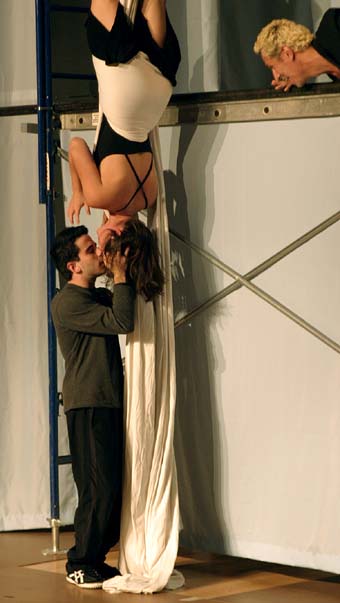
Troilus and Cressida in Stephen Wangh’s aerial production
As for the lovers together, their pledges of love to each other are very odd and epistemological:
TROILUS O virtuous fight, When right with right wars who shall be most right! True swains in love shall in the world to come Approve their truths by Troilus: when their rhymes, Full of protest, of oath and big compare, Want similes, truth tired with iteration, As true as steel, as plantage to the moon, As sun to day, as turtle to her mate, As iron to adamant, as earth to the centre, Yet, after all comparisons of truth, As truth’s authentic author to be cited, ‘As true as Troilus’ shall crown up the verse, And sanctify the numbers.
CRESSIDA Prophet may you be! If I be false, or swerve a hair from truth, When time is old and hath forgot itself, When waterdrops have worn the stones of Troy, And blind oblivion swallow’d cities up, And mighty states characterless are grated To dusty nothing, yet let memory, From false to false, among false maids in love, Upbraid my falsehood! when they’ve said ‘as false As air, as water, wind, or sandy earth, As fox to lamb, as wolf to heifer’s calf, Pard to the hind, or stepdame to her son,’ ‘Yea,’ let them say, to stick the heart of falsehood, ‘As false as Cressid.’
Are there any passages in Shakespeare that use the words “true” and “false” as incessantly as these two do, respectively? It’s numbing. And overblown: Cressida herself undermined the distinction in an earlier gabfest with Pandarus when she said “To say the truth, true and not true.” Troilus himself undermined it in the previous scene when he tautologically declared, “I am as true as truth’s simplicity,” spelling out the meaninglessness of the comparison with truth-values.
The speeches do set up Troilus later shrieking “False, false, false!” at Cressida in the last act, which, again, doesn’t quite rise to the level of King Lear here, especially considering that Cressida was just sold into slavery by her own people in exchange for the return of a prisoner. There’s no secret escape plan for Cressida this time, unlike in Chaucer, and her father Calchas, a defector to the Greeks, seems indifferent to her arrival. Her pledge to Diomedes is a bitter tactical move designed to save herself from becoming one of the “sluttish spoils of opportunity,” in the words of that fine fellow Ulysses. In light of the chaotic movement of the play and Troilus’ character, Cressida’s resignation and compromise with circumstance seems far more realistic than Troilus’ cloddish tantrums–although Troilus’ breakdown while Thersites jeers at him does contain genuine pathos. No, Cressida didn’t have to give Diomedes Troilus’ sleeve, but Shakespeare consciously weakened the case against Cressida (also by having her affair with Troilus last for hours rather than months, as in Chaucer).
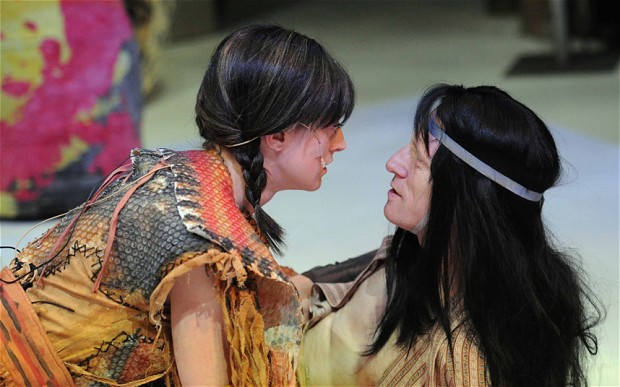
Troilus and Cressida as American Indians because why not?
And then there is Thersites on the Greek side. Thersites is pretty insufferable. At first he may seem like the truth-teller of the Iliad, but soon reveals himself to be far less. In the Iliad, he was clearly a threat. Moses Finley observed that Homer wouldn’t have bothered having Thersites speak out and be smacked down if what he said weren’t dangerous to the warrior caste. In Shakespeare, Thersites is ridiculed, beaten on, but generally tolerated, because he is defanged. His words have no bite, no matter how much he tries to give them. The deeper he digs himself into ridicule and cynicism, the more impotent he becomes. Not that he even seems to care about making a difference. Unlike his somewhat more decorous Trojan counterpart, Pandaraus, who turns from bawd to malevolent force over the play, Thersites just rants from the bleachers, amusing himself but no one else.
I think he is meant to be the point of identification for smug audiences who think themselves above it all, who want to laugh at the archaic heroics of Hector as well as the dumb romance of Troilus and Cressida (ably assisted by Shakespeare portraying them rather badly). But Thersites represents a dead end as much as Hector does. Both signify polar positions, dignity and cynicism, in a world that is too chaotic and stupefied to justify either.
So what do I see as the ultimate purpose here? A play that is designed to tempt the viewer with cynicism and then throw it back in its face. Yes, be apathetic and say a pox on all their houses, yes, be like Thersites. And look at who you’ll be: a prude, sex-hating and joyless, unable to affirm anything, ignored by everyone. This is what makes the play so apt today, because while it was just confusing to earlier audiences, recent productions have embraced Thersites’ position to the hilt, not realizing that a certain race-to-the-bottom critical mindset that refuses to endorse any clear values, lest they then be trumped by the next subversion, will produce nothing that any one will ever care about.
Yet when Cressida is led away to become a sex slave for the Greeks, some care has survived, that despite the hardened cynicism of nearly everyone, you would have to be a monster to embrace Thersites’ or Ulysses’ points of view. So maybe that is the challenge Shakespeare set himself: to trivialize things as much as possible and then at the end say, “Look, I still made you care.” It hasn’t always worked, judging by how hard people have come down on Cressida, but it works on me. The fatuous “True Troilus” and “False Cressida” speeches are an analogy for that goal–that even in light of the linguistic nonsense and exaggerated silliness of True and False made by Troilus and Cressida, we still aren’t willing to give up the very robust distinction between truth and falseness, and so even this very cynical and sophistic play has left us still giving them some affirmation.
Plus (1976) is, at its heart, an attempt to use language to portray a situation that defies language. It deserves to be called “stream of consciousness” far more than most novels that claim the term, but that only reinforces the sense that words are not quite right for the situation at hand.
That situation is a disembodied consciousness, quite literally a brain in a vat, though in this case the vat is a spaceship orbiting Earth, the brain extracted from a husband and father who had suffered something of a severe decline in health before being given the “opportunity” to participate in this creepy research program, where he shares the vessel with a large amount of plants. The consciousness is named Imp Plus. As his consciousness develops, it’s clear that Imp Plus (“he” for convention’s sake) is certainly not identical with his past human embodiment, even though he possesses fragments of his memories, which he struggles to comprehend.
The novel is, as far as I can tell, free of metafictional trickery. The story is told straight and the ambiguity is purely that of language, not of plot or narrative. But the language is intrinsically ambiguous here. McElroy’s ambition is to take the language used by embodied creatures and try to show how it might be applied in a situation where one’s interface with the world has completely broken down and been wholly altered: senses removed and replaced by new kinds of neural inputs.
Consequently, the novel remains concertedly in linguistic suspension for most of its length. McElroy makes clear that language would cease to work (in the pragmatic sense) in such a situation. This is both the novel’s caprice and its achievement: without the past human incarnation, Imp Plus would never have language, so the novel is not as much a description of its stream of consciousness as it is a waste product of it. Yet that is as much of a clue as to Imp Plus’s consciousness as we can possibly get.
He found it all around. It opened and was close. He felt it was himself, but felt it was more.
Imp Plus caved out. There was a lifting all around, and Imp Plus knew there was no skull. This lifting was good. But there had been another lifting and he had wanted it, but then the lifting had not been good. He did not want to go back to it. He did not know if that lifting had been bad. But this new lifting was good.
There were birds around, and they were still as shadows. Imp Plus knew birds, but not so still. Birds with tails longer than they were. The tails were right.
Imp Plus knew he had no eyes. Yet Imp Plus saw. Or persisted in seeing.
With sprouts, maybe.
Imp Plus did not have sockets, for if there were sockets where would they have been? There was no skull.
Sockets was a word.
These passages are from the first page. “Caved out” is the most striking coinage here: repurposing words to describe conscious experiences that words have never before described. What it is to “cave out” is not revealed or defined as such–the words are an approximation at best. Meaning is established through the sheer aggregation of such terms and how they relate to Imp Plus’s remaining memories in the time when he was embodied as a human.
And McElroy does this very well, or at least he remains utterly true to this conception and does not cheat by providing contrived linkages between Imp Plus’s words and his current reality. The language is as much as you’re going to get. McElroy is careful to reuse terms to provide a real integrity to Imp Plus’s consciousness. The novel truly does feel like the verbal portrayal of the evolution of a developing consciousness, no small achievement.
For the blue discharge showed its dart at once and more than once not just in the spot the Dim Echo might have been calling hypothalamus right above the furled flame now still more tightly furled. This time the discharge of line or dart went on longer or stronger against the Sun’s flood.
But this was not the change. The change was that from the caving-out, the caving-in, the breakage like a stretch where cushions of blood shot into cords that twisted narrower and narrower into instants like quanta, there was no pain.
As Imp Plus‘s consciousness develops, memories from his past surface, provided to him partly by his own Dim Echo. He hears voices from Ground Control, the menacingly ambitious Good Voice and the more vulnerable, though still unsettling, Acrid Voice. Aided by sun and vegetation, he begins to grow some sort of new body, Swamp Thing-style.
McElroy places such a burden on language that the plot remains subordinate for much of it. It is not a long novel, and much of its lengths owes not to plot but to McElroy setting up the webs and networks of phrases needed to help the reader triangulate what their usage means. But there is a Cold War feel to it, a certain power and terror placed in technology that has become far more diffuse today, where society no longer perceives the dangers of technology to be rooted singularly in their militarization and capacity for massive instantaneous destruction and death. But that period detail is submerged beneath the much less time-bound linguistic play.
After I’d finished Plus, Dan Visel helpfully sent me an essay McElroy wrote many years later, “Life Science,” discussing the book. I was impressed by how closely my impression matched McElroy’s description of what he intended the linguistic process to represent:
In a rhetoric at first narrow. As subtraction may shape an abstract. Implying shock, I thought, but maybe a kind of experience other than shock. Inclining. Hearing. Or some building of slow rudiments, a weighing, reaching touch through word itself – accreting surely painfully, but maybe not. Quizzically adding. Secretly getting there, I trusted.
Perhaps before we see, we hear, and, hearing, see the point, feel what is struggling to gather and locate. By association. By logic. By illogic in the questing text.
The discoveries of this being Imp Plus, indeed of being Imp Plus, measure themselves by a development of words, terms, modifiers like acts. In Plus, which is not an essay but a story, statements think themselves toward embodiment, thoughts thicken into tissue: language does not explain so much as be itself what it is about. But, though that sounds like poetry, language here is only partly finding words. It is a feature of an organism, evolved and re-evolving, in some sense silently reacting to at first a job agreed on.
McElroy says that the book is not aboutlanguage, and that is indeed true. McElroy justifies what could merely be linguistic theatrics by genuinely convincing that the linguistic deformations are coming about through a concrete though very aberrant situation. Such justification for linguistic experimentation is extremely rare, and since the other example that comes to mind is Riddley Walker, perhaps science fiction provides it more than most genres.
He summarizes that justification as follows:
[L]anguage, body, and thought are not only mutual metaphors but, much more, features of this organism developing in my realistic speculation the way parallel features of other organisms develop…So metaphor is tentatively displaced in favor of homology.
Here I depart a bit from McElroy, in that I see homology as being absorbed into metaphor, rather than displacing metaphor. While traditional notions of tenor and vehicle (in I.A. Richards’ terminology) or metaphier and metaphrand (in Julian Jaynes’ terminology) do not quite apply here due to the dislocation from any recognizable ground, I’ve long come to think that the seeming unity of the grounding of a metaphor is more illusion than truth. Metaphors for love do not operate on a concept any less fuzzy than what is occurring to Imp Plus, though it’s a concept that we deal with far more often than neurokinesthesis and plant-body formation. Homology becomes the root of metaphor in Plus because it’s all that Imp Plus has left.
In the essay, McElroy cites Richard Dawkins and Julian Jaynes (whose Origin of Consciousness in the Breakdown of the Bicameral Mind hadn’t yet been published when McElroy wrote Plus, or else I’d easily believe it had influenced McElroy), though I’m surprised he doesn’t cite Merleau-Ponty, whose philosophy of conscious embodiment seems to be close at hand throughout Plus. Perhaps I’m reading into it due to the shared subject matter, or perhaps Merleau-Ponty and McElroy, both beautiful writers, independently arrived at presentations of very similar truths.
I was even more surprised that McElroy compared Plus to the brilliant, tormented novels of brilliant, tormented Italian writer Carlo Emilio Gadda, an engineer who wrote That Awful Mess on Via Merulana and the unfinished Acquainted with Grief, as well as many untranslated works including what I’m told is a caustic and obscene portrait of Mussolini, Eros and Priapus. Gadda planted Celine-esque levels of cynicism and bile on top of his carefully written and plotted works, so his tone is drastically different from Plus. But going back through Gadda, I can see a more abstract similarity with Plus, in the way that details of human evil and wretchedness are put in place with a tighter relation to one another than in most fiction, not in the service of a facile psycholgism, but in service to real physical processes. McElroy quotes an early passage exactly to this effect:
Because Ingravallo, like certain of our philosophers, attributed a soul, indeed a lousy bastard of a soul, to that system of forces and probabilities which surrounds every human creature, and which is customarily called destiny.
Because McElroy is not dealing with human evil and wretchedness–not so baldly, anyway–the physical viscerality of the novel does not share an emotional viscearlity that accompanies Gadda, which is why I would never have made the connection. But on the level of craft the connection is clearly there.
A connection I did make was to Michael Berlyn’s early Infocom text adventure, Suspended (1983), in which you played the lucky winner of a contest to stay in cryogenic suspension for thousands of years while monitoring the vital infrastructure of a planet, only to be woken up when equpiment malfunction causes transportation, food, and environmental conditions to go haywire and start causing mass die-offs. Because you’re stuck in your little pod, you have to explore only through six robots, each of which has, at best, one sensory modality. (And the robot with vision starts off broken.) In particular, there’s the robot Poet, who diagnoses faulty current flow, but otherwise describes his environment in very analogical terms:
This is another fine mess you’ve got me into. Umm, umm umm! A processor sits on the floor, munching and spitting electrons. Button, button, who’s got the button while the socks ablaze with color. A brain tres sits in the primo socket, and a brain quart sits in the secondary socket.
Just for comparison, the dextrous Waldo says “A disfigured device sits in the first depression, and a bubbly device sits in the second depression,” and the wave-sensing Sensa says “A ruined device sits in the plus receptacle, and a seized device sits in the negative socket.” So they’re not so helpful either.
But Berlyn was dealing with some of the same issues, which was how to use human language in a situation where it would not naturally occur, and using stretched, but precise, analogies in a similar manner to McElroy. Gadda’s analogies are precise but also “realistic.” But that does not make them differ in kind from McElroy’s, or Poet’s.
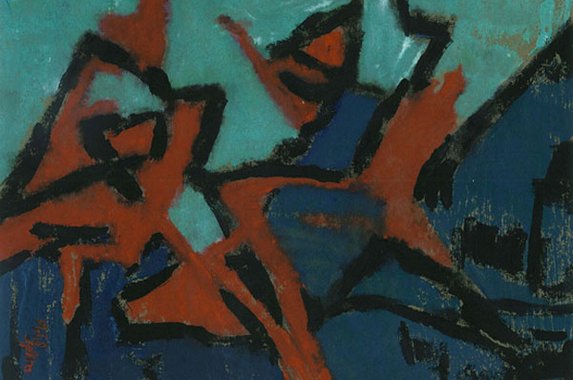
The Austrian writer and painter Mela Hartwig wrote Am I a Redundant Human Being circa 1931. It was not published until 2001 in German, and in English in 2010.
Our narrator, Luise, suffers from two afflictions of personality: first, a near-total lack of inspiration in how to live her life; and second, a painful awareness that leads her to self-immolating criticism. Neither of those alone would make for such a sad story, but Luise is also socially offputting, and she inspires little in others beyond bemusement and irritation. I think that one of the reasons this book hasn’t received much notice is that the novel will alienate someone not in sympathy with Luise’s peculiar afflictions. Hartwig does not make it easy to have sympathy for her; she doesn’t want to make it easy. That’s the point of the novel.
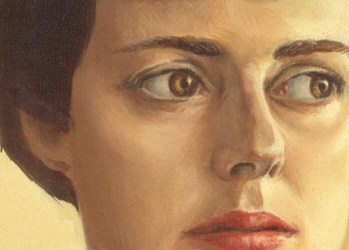
A Mela Hartwig painting from 1964.
The opening is explanation enough:
I’m a secretary. I have nearly twelve years of experience. My shorthand is first rate and I’m an excellent typist. I don’t mention it to brag. I just want to show that I amount to something. I’m ambitious.
I repeat: I’m ambitious. I’m hopelessly ambitious. Even though I certainly have reason to be humble. Reason enough to use modesty to avoid making the deficit between my talent and my ambition too obvious.
Luise is hard on herself, but not morally. Her wish is not to be a good person. She is not measuring herself against an ethical ideal or a societal model of what a woman should be (she confidently asserts that she is not unattractive, just nondescript), but against an aggressive inner conception she has for herself, whose origin is unclear. She wants to be something. It’s a very vague idea, and that’s her problem: she finds herself unable to fill it in, to flesh it out. She wants to be more passionate, more absorbed, more adventurous, but she has no preference for how these traits should express themselves.
Hartwig’s real achievement in this book is to keep the language at once abstract yet piercingly clear. It’s done quietly enough that it’s only by comparison with other mediocre novels of this sort that Am I a Redundant Human Being? appears superior. Hartwig is very sharp in expressing half-formed emotions and generalized frustrations in vivid language. (And credit to translator Kerri A. Pierce for rendering it well in English.) Hartwig sets up small loops of thought like these:
I didn’t use my ambition to demand more of myself than I was capable of giving–I simply used it to expect more of myself than I was capable of giving. (48)
My lack of diligence is even more inexplicable since I actually had a good example in my colleague that it would have been worth emulating. Of course, I had the desire to perform at her level, to become as capable as she was, to learn the art of standing out, of making myself indispensable–but at the same time, I was convinced that it was futile for me to want anything. (49)
Such thoughts are difficult to phrase so well.
So Luise looks to others for models, even while half-realizing that she is being stupid in doing so. She is “pathetically attracted” to her supremely confident schoolmate Johanna, then later experiences the rush of being in a political rally, melting into “The Mob,” and feeling passionate about something, only to lose all interest when she is once more alone.
She falls in with a couple men. There is Emil, whose love she pathologically doubts (for who could love her?) until he leaves her. But she is detached about the end of the relationship:
It hurt me to have lost him, but it hurt me even more to have lost his love…Dismayed, I realized that what I missed most about Emil K. was seeing myself through his eyes. Therefore, I reached an appalling conclusion: I could trust my pride, but not my heart. (61)
There’s Anton, whose love she doesn’t doubt, but whose love signifies his worthlessness:
However, I couldn’t overlook the fact that he was impressed by what I wanted to be, and couldn’t see me for what I really was. He respected me for my struggling to make something of myself without realizing that this struggle was futile. As they say, the proof was in the pudding: I came to see that my low opinion of him was perfectly justified. (67)
The ruthless logic of Luise’s self-criticism provides something of a shield for her against the world. After being seduced by a lying lothario, she feels tremendously betrayed, but also strangely liberated, for now she doubts others as well: “turning my doubt outward made it far easier to bear.” She doesn’t act like a victim should act–this makes her offputting.
This is not to say that Luise’s self-assessment is justified. That’s really beside the point. Several reviews complained that there was no seeming reason for her level of self-loathing, as though the lack of a clear cause makes her unconvincing. The point is that for every Johanna, there is a Luise, and we should understand that regardless of causes. Citing causes would excuse Luise as well as us from responsibility, and neither Hartwig nor Luise want that. The reader doesn’t get to be on the side of the angels while reading this novel.
The latter half of the book concerns her relationships with lovers Elizabeth and Egon. She first idolizes Elizabeth, who is described in terms eerily similar to that evoked by the description of Borderline Personality Disorder:
She was whoever she wanted to be at a given moment: the heroine of the novel she was reading, the protagonist of the tragedy or comedy she was rehearsing. Simply being herself wasn’t enough for her…Her will was strong. But it seems to me that she primarily used her will to deceive herself, to enable herself to believe wholeheartedly in the woman she was pretending to be, to feel completely at home in whatever character she’d just slipped into. (81)
Luise looks up to Elizabeth but because she wants to mimic Elizabeth and not enable her, Elizabeth doesn’t take to her too strongly. Luise has nothing to offer the borderline. No folie a deux results: Luise sees Elizabeth too clearly, envying her while exposing her. But after Elizabeth commits suicide as a result of her lover Egon leaving her, Luise sees her real chance, to take Elizabeth’s place. She pursues Egon.
It obviously doesn’t work out. While Egon is contemptuous and indifferent, unwilling to deign even to take advantage of Luise, Luise herself can’t commit fully to playing the role of Elizabeth. She makes a good go of it, but she can’t convince herself, nor can she convince Egon.
The book is not quite a tragedy. There’s something to Luise’s self-awareness that, if not liberating, possesses survival value. Luise does figure out what she’s doing, and she reconfigures her life so that she does not end up a passionate suicide like her erstwhile idol Elizabeth. It is an unsatisfying, limited life, especially relative to her insistent ambition. Perhaps part of her would actually prefer to be a passionate suicide, but there is also a stubborn pride to Luise’s attitude, an arrogance that makes her certain that she has seen the world aright. Perhaps if she had questioned that certainty….
The character of Luise reminds me most of Melanie in Maren Ade’s amazing film Forest for the Trees. Melanie absolutely fails to fit into her a new village as a schoolteacher, socializing with such clumsiness that her neediness is far too apparent. The lack of sympathy given her is at once understandable yet devastating. Eva Löbau gives a performance that apparently irritated a lot of reviewers, but which I found both astonishingly focused and painful. (The movies of Lodge Kerrigan have this quality as well.)
I imagine that Luise too projected this air, at once desperate yet harshly insistent.
There’s little in the book that pins it to its era. The austere narrative doesn’t seem representative of typical German-language writers at the time, male or female, though I’m just not familiar with enough of the latter to be certain. Hartwig was Jewish, but that also does not make itself explicitly felt in the novel. Hartwig has very little in common with her contemporary Anna Seghers and pretty much nothing in common with Margarete Böhme. If anything, her style is more reminiscent of postwar writers who adopted more stripped-down tactics, such as Max Frisch and Adelheid Duvanel.
But this only underscores the immense absence of women’s voices throughout the history of literature, and how difficult it is to assess to what extent Hartwig portrays a female voice versus an unheard voice, for the two categories overlap but do not coincide. Certainly the early modern lineage of German woman writers like Elsbeth von Oye,Rachel Akerman, Margarethe von Kuntsch, Sophie von La Roche, Karoline von Günderrode, and Bettina von Arnim charts out a very different path than the corresponding pathways in English. I’m unsure of where on the line Hartwig falls, but if I had to guess, it’s rather far off the middle. All the better.
Two other reviews that capture the distinctive nature of the novel and of Luise herself are those of Daniela Hurezanu and Matthew Jakubowski.